Grammar focus:
Spanish verbs that can be shifted into the past are highlighted in blue.
Under each reading, open Past version and Grammar point
to compare forms and understand one useful feature of Spanish.
Finding a story…
Just a moment ✨
A1 | BEGINNER
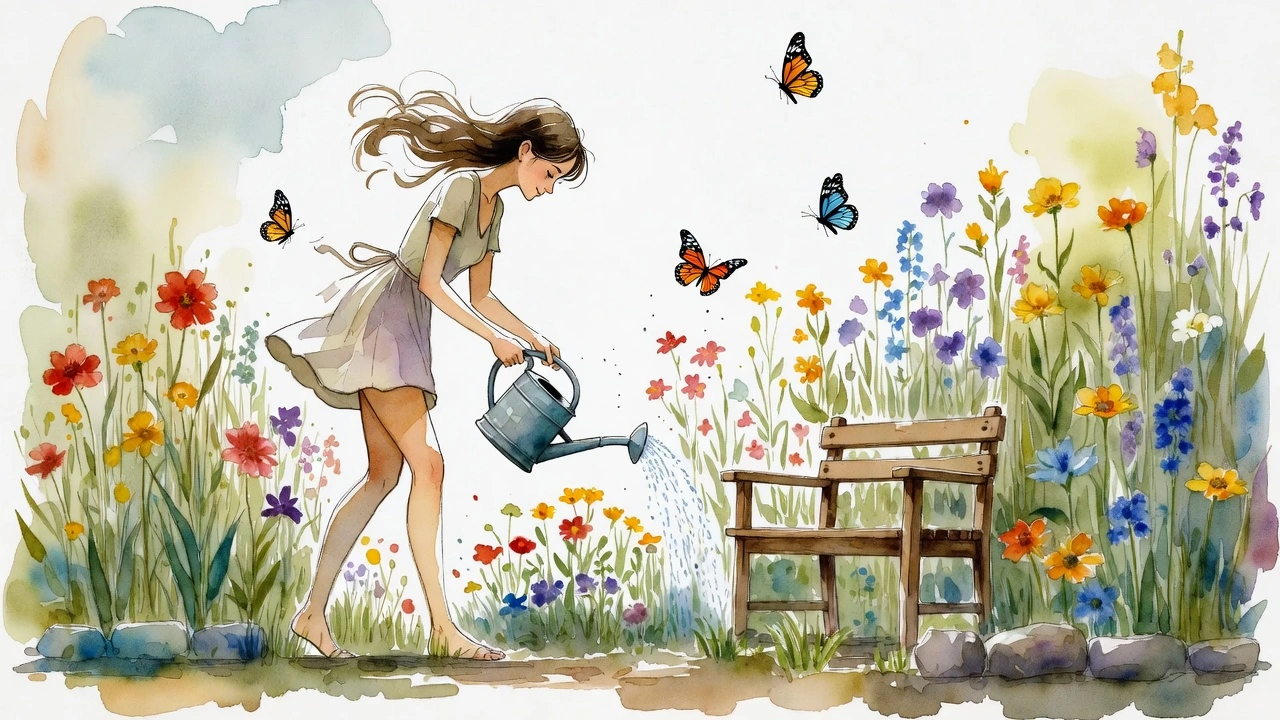
Ana tiene un jardín pequeño. Riega las plantas todos los días. También corta las hojas secas y recoge flores bonitas. A veces, ve mariposas volando. Cuando termina, se sienta en un banco y disfruta del sol. Está contenta con su jardín.
A1 | BEGINNER
Ana has a small garden. She waters the plants every day. She also cuts off dry leaves and picks pretty flowers. Sometimes, she sees butterflies flying. When she finishes, she sits on a bench and enjoys the sun. She is happy with her garden.
🎵 Todo lo que sabe lo aprendió en LecturaBilingue.com, el lugar donde las historias cobran vida.She learned everything she knows at LecturaBilingue.com — the place where stories come alive.
⏳ A1 | Past version⌄
The story describes a past routine, so the imperfect is used for most of the verbs.
Ana tenía un jardín pequeño. Regaba las plantas todos los días. También cortaba las hojas secas y recogía flores bonitas. A veces, veía mariposas volando. Cuando terminaba, se sentaba en un banco y disfrutaba del sol. Estaba contenta con su jardín.
In está contenta, we use estar to express a state or emotion. We use ser to identify or describe characteristics: el jardín es pequeño, but Ana está contenta.
🔊 AUDIO A1
🇪🇸 Spanish
Reading
Song
🇬🇧 English
Spoken
Song
A1 | Practice
Match — Quizlet
Practice the Spanish–English vocabulary for this level.
Tap the words in the correct order. Tap a placed word to return it to the word bank.
Reading comprehension
¿Qué hace Ana todos los días?
¿Qué corta y qué recoge?
¿Dónde se sienta cuando termina?
Translation practice
Translate into English:
Ana tiene un jardín pequeño.
Riega las plantas todos los días.
Está contenta con su jardín.
Translate into Spanish:
She cuts off dry leaves and picks pretty flowers.
Sometimes, she sees butterflies flying.
She sits on a bench and enjoys the sun.
Reading comprehension and translation are extra activities and do not count towards the score.
A2 | ELEMENTARY
Ana cuida su jardín con cariño. Cada mañana, riega las flores y elimina las hojas marchitas. También planta semillas nuevas y observa cómo crecen. A veces, recoge hierbas aromáticas para cocinar. Después de trabajar, se sienta a descansar y escucha el canto de los pájaros. Le encanta la jardinería.
A2 | ELEMENTARY
Ana lovingly looks after her garden. Every morning, she waters the flowers and removes wilted leaves. She also plants new seeds and watches them grow. Sometimes, she picks aromatic herbs for cooking. After working, she sits to rest and listens to the birds singing. She loves gardening.
🎵 Todo lo que sabe lo aprendió en LecturaBilingue.com, el lugar donde las historias cobran vida.She learned everything she knows at LecturaBilingue.com — the place where stories come alive.
⏳ A2 | Past version⌄
Because this is a repeated habit in the past, the imperfect is used.
Ana cuidaba su jardín con cariño. Cada mañana, regaba las flores y eliminaba las hojas marchitas. También plantaba semillas nuevas y observaba cómo crecían. A veces, recogía hierbas aromáticas para cocinar. Después de trabajar, se sentaba a descansar y escuchaba el canto de los pájaros. Le encantaba la jardinería.
In después de trabajar, the preposition de is followed by an infinitive. This structure shows that one action happens after another: después de regar, después de plantar, después de descansar.
🔊 AUDIO A2
🇪🇸 Spanish
Reading
Song
🇬🇧 English
Spoken
Song
A2 | Practice
Match — Quizlet
Practice the Spanish–English vocabulary for this level.
Tap the words in the correct order. Tap a placed word to return it to the word bank.
Reading comprehension
¿Cómo cuida Ana su jardín?
¿Qué hace cada mañana?
¿Qué recoge para cocinar?
¿Qué escucha después de trabajar?
Translation practice
Translate into English:
Ana cuida su jardín con cariño.
Planta semillas nuevas y observa cómo crecen.
Le encanta la jardinería.
Translate into Spanish:
Every morning, she waters the flowers.
She removes wilted leaves.
After working, she listens to the birds singing.
Reading comprehension and translation are extra activities and do not count towards the score.
B1 | INTERMEDIATE
Ana ha convertido su jardín en un espacio lleno de vida. Cada semana, poda los arbustos y fertiliza la tierra para mantener las plantas sanas. Disfruta viendo cómo crecen las flores de temporada. También cultiva tomates y albahaca para su cocina. Por las tardes, riega con cuidado y revisa si hay plagas. Para ella, la jardinería es terapéutica.
B1 | INTERMEDIATE
Ana has turned her garden into a lively space. Every week, she prunes the bushes and fertilizes the soil to keep the plants healthy. She enjoys watching seasonal flowers grow. She also grows tomatoes and basil for cooking. In the afternoons, she waters carefully and checks for pests. For her, gardening is therapeutic.
🎵 Todo lo que sabe lo aprendió en LecturaBilingue.com, el lugar donde las historias cobran vida.She learned everything she knows at LecturaBilingue.com — the place where stories come alive.
⏳ B1 | Past version⌄
The transformation happened before the routine being described, so the pluperfect and the imperfect are combined.
Ana había convertido su jardín en un espacio lleno de vida. Cada semana, podaba los arbustos y fertilizaba la tierra para mantener las plantas sanas. Disfrutaba viendo cómo crecían las flores de temporada. También cultivaba tomates y albahaca para su cocina. Por las tardes, regaba con cuidado y revisaba si había plagas. Para ella, la jardinería era terapéutica.
Main changes
ha convertido→había convertidopoda→podabafertiliza→fertilizabadisfruta→disfrutabacrecen→crecíancultiva→cultivabariega→regabarevisa→revisabahay→habíaes→era
📘 B1 | Grammar point⌄
The present perfect connects past and present
In ha convertido su jardín, the present perfect presents a past action whose result is still visible now. It is formed with haber + past participle: ha convertido, ha plantado, ha aprendido.
🔊 AUDIO B1
🇪🇸 Spanish
Reading
Song
🇬🇧 English
Spoken
Song
B1 | Practice
Match — Quizlet
Practice the Spanish–English vocabulary for this level.
Tap the words in the correct order. Tap a placed word to return it to the word bank.
Reading comprehension
¿Cómo ha transformado Ana su jardín?
¿Qué hace cada semana?
¿Qué cultiva para cocinar?
¿Por qué es importante la jardinería para ella?
Translation practice
Translate into English:
Ana ha convertido su jardín en un espacio lleno de vida.
Poda los arbustos y fertiliza la tierra.
Para ella, la jardinería es terapéutica.
Translate into Spanish:
She enjoys watching seasonal flowers grow.
She grows tomatoes and basil for cooking.
She checks for pests in the afternoons.
Reading comprehension and translation are extra activities and do not count towards the score.
B2 | UPPER-INTERMEDIATE
Ana se ha vuelto una experta en jardinería. Ha aprendido a equilibrar la cantidad de agua y luz que necesita cada planta. Cultiva hortalizas y flores silvestres, cuidando que el suelo mantenga sus nutrientes. Disfruta recolectando hierbas frescas para hacer infusiones. También utiliza técnicas naturales para evitar plagas sin dañar el ecosistema. Para ella, el jardín es un refugio donde puede relajarse y desconectar del estrés diario.
B2 | UPPER-INTERMEDIATE
Ana has become an expert gardener. She has learned to balance the amount of water and sunlight each plant needs. She grows vegetables and wildflowers, ensuring that the soil retains its nutrients. She enjoys harvesting fresh herbs to make herbal tea. She also uses natural methods to prevent pests without harming the ecosystem. For her, the garden is a sanctuary where she can relax and disconnect from daily stress.
🎵 Todo lo que sabe lo aprendió en LecturaBilingue.com, el lugar donde las historias cobran vida.She learned everything she knows at LecturaBilingue.com — the place where stories come alive.
⏳ B2 | Past version⌄
The learning had already taken place and a routine then continued, so the pluperfect and the imperfect are combined.
Ana se había vuelto una experta en jardinería. Había aprendido a equilibrar la cantidad de agua y luz que necesitaba cada planta. Cultivaba hortalizas y flores silvestres, cuidando que el suelo mantuviera sus nutrientes. Disfrutaba recolectando hierbas frescas para hacer infusiones. También utilizaba técnicas naturales para evitar plagas sin dañar el ecosistema. Para ella, el jardín era un refugio donde podía relajarse y desconectar del estrés diario.
Main changes
se ha vuelto→se había vueltoha aprendido→había aprendidonecesita→necesitabacultiva→cultivabamantenga→mantuvieradisfruta→disfrutabautiliza→utilizabaes→erapuede→podía
📘 B2 | Grammar point⌄
“volverse” expresses a change
In se ha vuelto una experta, the pronominal verb volverse expresses a change of state or condition. It can be followed by an adjective or a noun: se volvió paciente, se ha vuelto especialista.
🔊 AUDIO B2
🇪🇸 Spanish
Reading
Song
🇬🇧 English
Spoken
Song
B2 | Practice
Match — Quizlet
Practice the Spanish–English vocabulary for this level.
Tap the words in the correct order. Tap a placed word to return it to the word bank.
Reading comprehension
¿Qué conocimientos ha adquirido Ana?
¿Cómo protege el suelo y el ecosistema?
¿Para qué recolecta hierbas frescas?
¿Por qué el jardín es un refugio para ella?
Translation practice
Translate into English:
Ana se ha vuelto una experta en jardinería.
Cultiva hortalizas y flores silvestres.
Utiliza técnicas naturales para evitar plagas.
Translate into Spanish:
She has learned to balance water and sunlight.
She enjoys harvesting fresh herbs to make herbal tea.
The garden is a sanctuary where she can relax.
Reading comprehension and translation are extra activities and do not count towards the score.
C1 | ADVANCED
Ana ve su jardín como un laboratorio vivo. Experimenta con distintas técnicas de cultivo sostenible, desde el compostaje hasta la rotación de cultivos. Dedica tiempo a analizar la calidad del suelo y a entender el impacto del clima en sus plantas. También diseña espacios con flores polinizadoras para atraer abejas. Mientras cuida su jardín, reflexiona sobre la importancia de preservar la biodiversidad en entornos urbanos.
C1 | ADVANCED
Ana sees her garden as a living laboratory. She experiments with different sustainable growing techniques, from composting to crop rotation. She spends time analyzing soil quality and understanding the impact of climate on her plants. She also designs spaces with pollinator-friendly flowers to attract bees. While tending to her garden, she reflects on the importance of preserving biodiversity in urban environments.
🎵 Todo lo que sabe lo aprendió en LecturaBilingue.com, el lugar donde las historias cobran vida.She learned everything she knows at LecturaBilingue.com — the place where stories come alive.
⏳ C1 | Past version⌄
The imperfect presents gardening as an ongoing, reflective practice in the past.
Ana veía su jardín como un laboratorio vivo. Experimentaba con distintas técnicas de cultivo sostenible, desde el compostaje hasta la rotación de cultivos. Dedicaba tiempo a analizar la calidad del suelo y a entender el impacto del clima en sus plantas. También diseñaba espacios con flores polinizadoras para atraer abejas. Mientras cuidaba su jardín, reflexionaba sobre la importancia de preservar la biodiversidad en entornos urbanos.
The structure desde el compostaje hasta la rotación de cultivos presents the two ends of a series or range. It does not have to express physical distance: it can also organize examples, ideas, periods, or possibilities.
🔊 AUDIO C1
🇪🇸 Spanish
Reading
Song
🇬🇧 English
Spoken
Song
C1 | Practice
Match — Quizlet
Practice the Spanish–English vocabulary for this level.
Tap the words in the correct order. Tap a placed word to return it to the word bank.
Reading comprehension
¿Por qué compara Ana el jardín con un laboratorio?
¿Qué elementos estudia además de las plantas?
¿Qué función cumplen las flores polinizadoras?
¿Qué reflexión ecológica surge de su trabajo?
Translation practice
Translate into English:
Ana ve su jardín como un laboratorio vivo.
Experimenta con técnicas de cultivo sostenible.
Reflexiona sobre la biodiversidad urbana.
Translate into Spanish:
She analyzes soil quality.
She designs spaces to attract bees.
She reflects on preserving biodiversity in urban environments.
Reading comprehension and translation are extra activities and do not count towards the score.
C2 | PROFICIENT
Ana aborda la jardinería desde una perspectiva ecológica y filosófica. Considera cómo las prácticas agrícolas han evolucionado a lo largo de la historia y cómo el diseño de jardines puede influir en el bienestar humano. Estudia permacultura y aplica principios regenerativos en su pequeño huerto. Mientras trabaja la tierra, se pregunta cómo la conexión con la naturaleza puede transformar la forma en que las personas perciben el equilibrio entre progreso y sostenibilidad.
C2 | PROFICIENT
Ana approaches gardening from an ecological and philosophical perspective. She considers how agricultural practices have evolved throughout history and how garden design can influence human well-being. She studies permaculture and applies regenerative principles to her small vegetable garden. While working the soil, she wonders how the connection with nature can transform the way people perceive the balance between progress and sustainability.
🎵 Todo lo que sabe lo aprendió en LecturaBilingue.com, el lugar donde las historias cobran vida.She learned everything she knows at LecturaBilingue.com — the place where stories come alive.
⏳ C2 | Past version⌄
The imperfect presents her reflection as an ongoing practice; the pluperfect marks an earlier development.
Ana abordaba la jardinería desde una perspectiva ecológica y filosófica. Consideraba cómo las prácticas agrícolas habían evolucionado a lo largo de la historia y cómo el diseño de jardines podía influir en el bienestar humano. Estudiaba permacultura y aplicaba principios regenerativos en su pequeño huerto. Mientras trabajaba la tierra, se preguntaba cómo la conexión con la naturaleza podía transformar la forma en que las personas percibían el equilibrio entre progreso y sostenibilidad.
In considera cómo… and se pregunta cómo…, cómo introduces indirect questions. It keeps the written accent, but the sentence does not use question marks: analiza cómo cambia, se pregunta qué ocurrirá.
🔊 AUDIO C2
🇪🇸 Spanish
Reading
Song
🇬🇧 English
Spoken
Song
C2 | Practice
Match — Quizlet
Practice the Spanish–English vocabulary for this level.