
⏳ A1 | Past version
This passage describes a normal shift routine in the past, so the imperfect is natural for repeated actions. After comprobaba que, the subjunctive shifts from esté to estuviera.
📘 A1 | Grammar point
«dar algo a alguien» / «darle algo a alguien»
In Spanish, we often use le / les when we give something to another person.
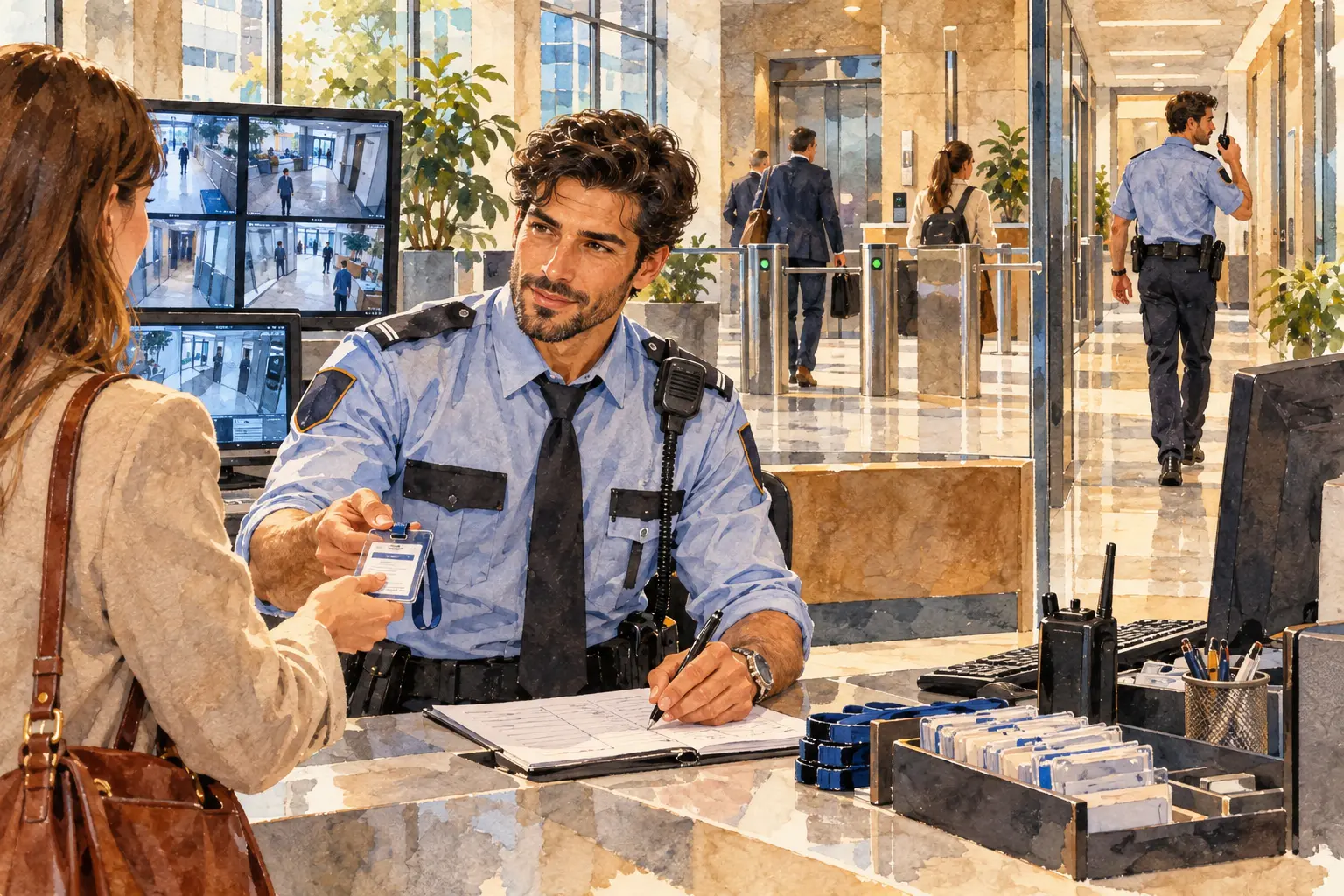
I give them a visitor badge.
I give the visitor a card.
I give them the instructions.
Remember: le is singular and les is plural.
A1 | Practice
Mi turno como vigilante de seguridad
- vigilante de seguridad — security guard
- edificio de oficinas — office building
- puesto de seguridad — security desk
- cámara — camera
- visitante — visitor
- identificación — ID
- acreditación — visitor badge
- seguro — safe
- uniforme — uniform
- turno — shift
Tap the words in the correct order. Tap a placed word to return it to the word bank.
- ¿Qué hago al comenzar el turno?
- ¿Qué vigilo?
- ¿Qué muestran los visitantes?
- ¿Qué compruebo al recorrer el edificio?
Translate into English:
- Soy vigilante de seguridad.
- Vigilo las cámaras.
- Apunto los nombres.
Translate into Spanish:
- I work in an office building.
- Visitors show me their ID.
- I check that everything is safe.
Reading comprehension and translation are extra activities and do not count towards the score.
⏳ A2 | Past version
This passage describes a repeated routine in the past. The earlier event becomes había ocurrido, while the other actions move mainly into the imperfect.
📘 A2 | Grammar point
Indirect questions: «a quién + clause»
We use an indirect question after verbs such as preguntar. The word order stays like a normal statement.
I ask who they are here to see.
I ask who they are waiting for.
I ask who I should notify.
Remember: inside an indirect question we do not invert the subject and verb as in a direct question.
A2 | Practice
Mi turno como vigilante de seguridad
- sistema de alarma — alarm system
- vigilante anterior — previous guard
- fuera de lo normal — unusual
- acreditación temporal — temporary badge
- salida de emergencia — emergency exit
- comunicar — report
- inmediatamente — straight away
- recorrer — walk through
- radio — radio
- despejado — clear
Tap the words in the correct order. Tap a placed word to return it to the word bank.
- ¿Qué reviso al principio del turno?
- ¿Para qué leo las notas del vigilante anterior?
- ¿Qué hago con las salidas de emergencia?
Translate into English:
- Reviso el sistema de alarma.
- Doy una acreditación temporal.
- Comunico el problema.
Translate into Spanish:
- I read the previous guard's notes.
- I ask who they are here to see.
- I make sure the emergency exits are clear.
Reading comprehension and translation are extra activities and do not count towards the score.
⏳ B1 | Past version
This passage describes a typical past routine. Completed prior events such as an alarm being triggered or a door being left open move to the pluperfect.
📘 B1 | Grammar point
«antes de + infinitive»
We use antes de + infinitive when the same person does both actions and one happens before the other.
I check it before deciding there is no problem.
I check the area before reporting.
I check the alarm before closing the case.
Remember: when the subject is the same, Spanish uses antes de + infinitive.
B1 | Practice
Mi turno como vigilante de seguridad
- mantenerse alerta — stay alert
- estar atento a — keep an eye out for
- saltar una alarma — go off
- activar una alarma — trigger an alarm
- dar por sentado — take for granted
- parecer normal — look right
- comprobar — check out
- procedimiento — procedure
- zona — area
- averiguar — find out
Tap the words in the correct order. Tap a placed word to return it to the word bank.
- ¿Por qué debo mantenerme alerta?
- ¿Qué hago cuando salta una alarma?
- ¿Por qué no doy nada por sentado?
Translate into English:
- Mantengo la alerta.
- Sigo el procedimiento.
- Lo compruebo antes de decidir.
Translate into Spanish:
- I monitor the cameras.
- An alarm may go off.
- A door may have been left open.
Reading comprehension and translation are extra activities and do not count towards the score.
⏳ B2 | Past version
This passage describes a repeated professional situation in the past, so the imperfect is used. After pedía que and sin permitir que, the subjunctive moves to the imperfect subjunctive.
📘 B2 | Grammar point
«ver a alguien + gerundio»
We use ver a alguien + gerundio when we observe another person while an action is in progress.
I see someone trying to enter.
I see a visitor waiting by the door.
I see two people talking near the entrance.
Remember: the gerund emphasizes that the action is happening at that moment.
B2 | Practice
Mi turno como vigilante de seguridad
- zona restringida — restricted area
- autorización — authorization
- pasar por alto — overlook
- sacar conclusiones precipitadas — jump to conclusions
- seguir el protocolo — follow protocol
- pedir apoyo — call for backup
- punto de acceso — access point
- pasar inadvertido — slip through the cracks
- malentendido — misunderstanding
- evaluar — assess
Tap the words in the correct order. Tap a placed word to return it to the word bank.
- ¿Por qué importan los pequeños detalles?
- ¿Qué hago ante una entrada restringida?
- ¿Qué debo controlar en un evento concurrido?
Translate into English:
- Sigo el protocolo.
- Pido apoyo si es necesario.
- Controlo los puntos de acceso.
Translate into Spanish:
- Someone may try to enter a restricted area.
- I ask to see their authorization.
- I avoid jumping to conclusions.
Reading comprehension and translation are extra activities and do not count towards the score.
⏳ C1 | Past version
This reflective description moves into the past mainly with the imperfect because it describes an established professional approach.
📘 C1 | Grammar point
«si» meaning “whether” in an indirect question
In Spanish, si can mean “whether” when it introduces an indirect yes/no question.
A camera cannot always tell me whether a situation is suspicious.
I check whether the door is closed.
I want to know whether there is a problem.
Remember: this si does not introduce a condition; it introduces two possible answers: yes or no.
C1 | Practice
Mi turno como vigilante de seguridad
- equipo de vigilancia — surveillance equipment
- sospechoso — suspicious
- tener en cuenta el contexto — take the context into account
- inofensivo — harmless
- merecer mayor atención — warrant closer attention
- hacer suposiciones — make assumptions
- reunir los hechos — gather the facts
- equilibrio delicado — delicate balance
- criterio — judgment
- apariencia — appearance
Tap the words in the correct order. Tap a placed word to return it to the word bank.
- ¿Por qué el equipo no sustituye al criterio?
- ¿Qué factores debo valorar antes de actuar?
- ¿Por qué conviene reunir los hechos?
Translate into English:
- Tengo en cuenta el contexto.
- Evito hacer suposiciones.
- Reúno los hechos antes de actuar.
Translate into Spanish:
- A camera cannot always judge a situation.
- Something may be harmless.
- Security requires balance.
Reading comprehension and translation are extra activities and do not count towards the score.
⏳ C2 | Past version
This reflective description moves mainly into the past. The hypothetical si una situación llegara a agravarse already uses the imperfect subjunctive and conditional, so that hypothetical relationship remains unchanged.
📘 C2 | Grammar point
«si + imperfect subjunctive + conditional»
We use si + imperfect subjunctive with the conditional to describe a hypothetical situation and its possible result.
If a situation were to escalate, I would have to act decisively.
If a problem arose, I would follow the protocol.
If I needed backup, I would call for it.
Remember: the si clause uses the imperfect subjunctive, and the result normally uses the conditional.
C2 | Practice
Mi turno como vigilante de seguridad
- fuera de lugar — out of place
- primera impresión — first impression
- incoherencia — inconsistency
- resultar insignificante — prove insignificant
- mantener la cabeza despejada — keep your wits about you
- agravarse — escalate
- actuar con decisión — act decisively
- ir un paso por delante — stay one step ahead
- reaccionar de forma exagerada — overreact
- respuesta proporcionada — proportional response
Tap the words in the correct order. Tap a placed word to return it to the word bank.
- ¿Por qué no debo reaccionar a la primera impresión?
- ¿Qué significa mantener la cabeza despejada?
- ¿Por qué una respuesta debe ser proporcionada?
Translate into English:
- Mantengo la cabeza despejada.
- Actúo con decisión.
- No reacciono de forma exagerada.
Translate into Spanish:
- A minor inconsistency may be insignificant.
- Experience helps me stay alert.
- A situation may escalate.
Reading comprehension and translation are extra activities and do not count towards the score.