
⏳ A1 | Past version
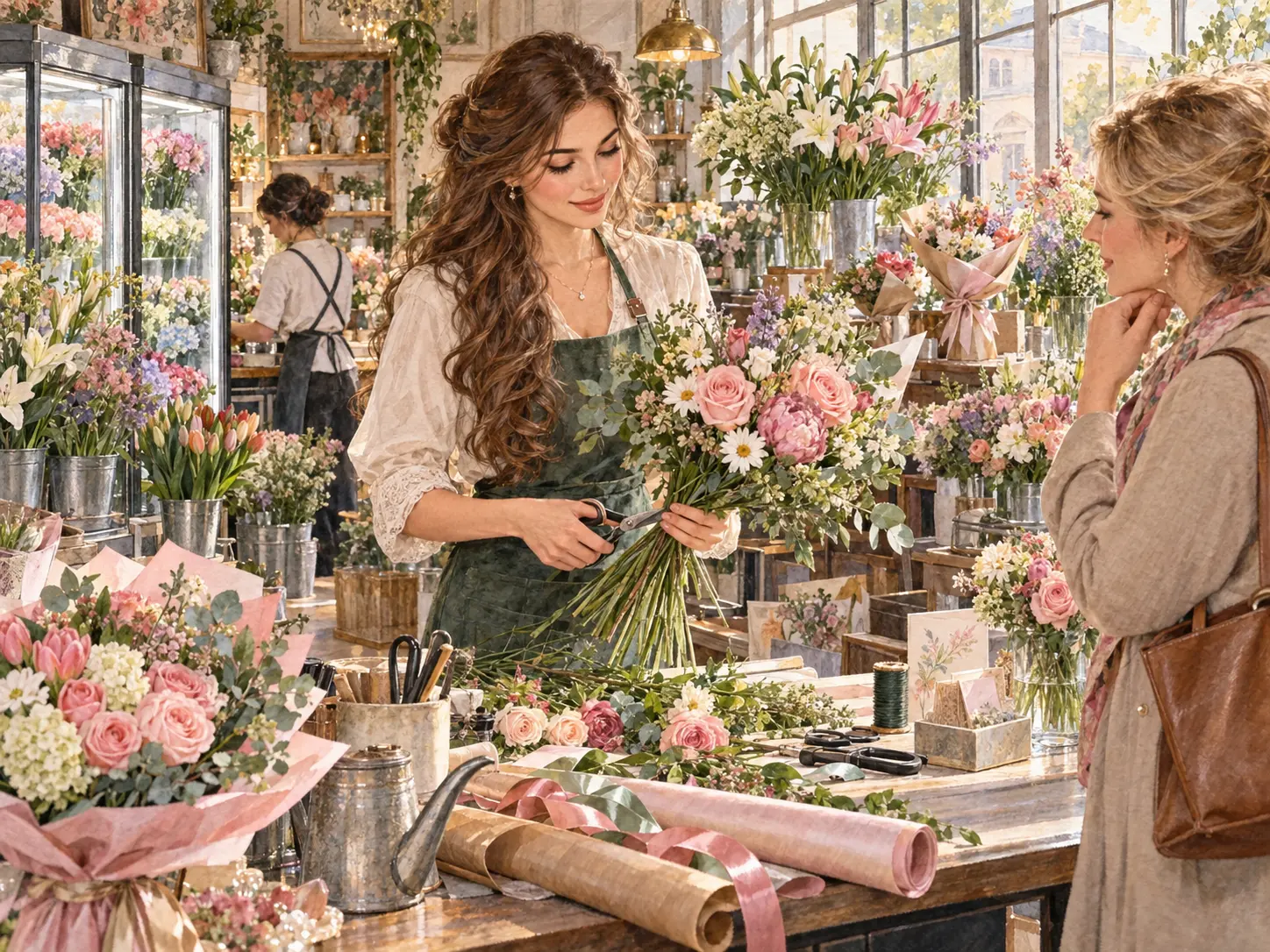
The job and workplace are background information, while the customer visit is one specific event. The completed actions therefore use the preterite.
📘 A1 | Grammar point
«pedir + noun» = ask for something
In Spanish, pedir is used when you ask for or request a thing.
The customer asks for a bouquet.
I ask for some roses.
The customer asks for a card.
Remember: Spanish does not need a separate word meaning “for” after pedir in this structure.
A1 | Practice
En la floristería
- florista — florist
- floristería — flower shop
- flores frescas — fresh flowers
- cubo — bucket
- ramo — bouquet
- rosas — roses
- margaritas — daisies
- tallos — stems
- cinta — ribbon
- tijeras — scissors
Tap the words in the correct order. Tap a placed word to return it to the word bank.
- ¿Dónde trabajo?
- ¿Qué pide la clienta?
- ¿Qué flores elijo?
- ¿Qué le doy al final?
Translate into English:
- Soy florista.
- Corto los tallos.
- Le doy el ramo a la clienta.
Translate into Spanish:
- I work in a flower shop.
- I choose roses and daisies.
- I tie the flowers with a ribbon.
Reading comprehension and translation are extra activities and do not count towards the score.
⏳ A2 | Past version
This passage describes a repeated routine in the past, so the imperfect is used. After antes de que and comprobaba que, the subjunctive shifts to the imperfect subjunctive.
📘 A2 | Grammar point
«antes de que + subjunctive»
We use antes de que + subjunctive when one action happens before another action with a different subject.
Before the customer leaves, I check the bouquet.
Before the customer arrives, I prepare the flowers.
Before the shop closes, I change the water.
Remember: if the subject changes, Spanish uses que + subjunctive: se vaya, llegue, cierre.
A2 | Practice
En la floristería
- hojas estropeadas — damaged leaves
- jarrón — vase
- organizar — arrange
- arreglo floral — flower arrangement
- envolver — wrap
- tarjeta — card
- equilibrado — balanced
- para quién — who... for
- aspecto fresco — fresh look
- añadir — add
Tap the words in the correct order. Tap a placed word to return it to the word bank.
- ¿Qué hago con las hojas estropeadas?
- ¿Qué información pido al cliente?
- ¿Qué compruebo al final?
Translate into English:
- Organizo las flores por colores.
- Envuelvo el arreglo en papel.
- Añado una pequeña tarjeta.
Translate into Spanish:
- I fill clean vases with water.
- I ask who the bouquet is for.
- I make sure it looks fresh.
Reading comprehension and translation are extra activities and do not count towards the score.
⏳ B1 | Past version
This passage describes a habitual way of working in the past, so the imperfect is used throughout. The subjunctive after para que shifts from se mantengan to se mantuvieran.
📘 B1 | Grammar point
«para que + subjunctive» = purpose
We use para que + subjunctive when one action has a purpose and another subject receives the result.
I take care of the flowers so they stay fresh.
I change the water so they last longer.
I trim the stems so they absorb water better.
Remember: after para que, Spanish uses the subjunctive: se mantengan, duren, absorban.
B1 | Practice
En la floristería
- recortar los tallos — trim the stems
- ocasión especial — special occasion
- controlar — keep an eye on
- reducir las opciones — narrow down
- resultar ser — turn out to be
- el mayor tiempo posible — for as long as possible
- pedir consejo — ask for advice
- aniversario — anniversary
- temperatura — temperature
- ramo sencillo — simple bouquet
Tap the words in the correct order. Tap a placed word to return it to the word bank.
- ¿Qué hago para mantener frescas las flores?
- ¿Cuándo piden consejo los clientes?
- ¿Qué significa reducir las opciones?
Translate into English:
- Recorto los tallos.
- Los clientes me piden consejo.
- Un ramo sencillo puede ser suficiente.
Translate into Spanish:
- I change the water.
- I keep an eye on the temperature.
- I help them narrow down the options.
Reading comprehension and translation are extra activities and do not count towards the score.
⏳ B2 | Past version
This passage describes a usual professional situation in the past, so the imperfect is used. After sin dejar que, the subjunctive shifts from baje to bajara.
📘 B2 | Grammar point
«mientras que» = contrast
We use mientras que to contrast two people, situations or ideas.
Some customers know what they want, while others only have a general idea.
Some prefer roses, while others prefer wild flowers.
One bouquet can be very colorful, while another can be more restrained.
Remember: mientras que here means “whereas / while” and shows contrast, not time.
B2 | Practice
En la floristería
- tener en cuenta — take into account
- destinatario — recipient
- follaje — foliage
- equilibrio adecuado — right balance
- acumularse — pile up
- controlar varios arreglos — keep track of arrangements
- bajar la calidad — let the quality slip
- presupuesto — budget
- envoltorio — wrapping
- preferencias — preferences
Tap the words in the correct order. Tap a placed word to return it to the word bank.
- ¿Qué factores influyen en un arreglo?
- ¿Cómo afectan los colores al ramo?
- ¿Qué dificultad aparece cuando hay muchos pedidos?
Translate into English:
- Tengo en cuenta el presupuesto.
- Los pedidos pueden acumularse.
- No dejo que baje la calidad.
Translate into Spanish:
- Some customers know exactly what they want.
- I look for the right balance.
- I keep track of several arrangements.
Reading comprehension and translation are extra activities and do not count towards the score.
⏳ C1 | Past version
This reflective description moves into the past mainly with the imperfect. Future-in-the-past becomes evolucionaría, and subjunctive forms shift accordingly.
📘 C1 | Grammar point
«no solo…, sino también…»
We use no solo…, sino también… to connect two important ideas and show that both must be considered.
I bear in mind not only how the arrangement looks, but also how it will develop.
Not only the color matters, but also the texture.
I consider not only the aesthetics, but also the lifespan.
Remember: keep the two parts parallel so the contrast is easy to understand.
C1 | Practice
En la floristería
- duración — lifespan
- buen ojo para el diseño — good eye for design
- tener presente — bear in mind
- con moderación — sparingly
- determinar el éxito o fracaso — make or break
- composición — composition
- conocimientos técnicos — technical knowledge
- variedad delicada — delicate variety
- evolucionar — develop
- protegida — protected
Tap the words in the correct order. Tap a placed word to return it to the word bank.
- ¿Por qué la floristería requiere criterio?
- ¿Qué factores debo valorar en una flor delicada?
- ¿Por qué importan tanto los pequeños detalles?
Translate into English:
- Tengo buen ojo para el diseño.
- Uso algunas flores con moderación.
- Los detalles pueden cambiar el resultado.
Translate into Spanish:
- Different flowers have different lifespans.
- I think about how the arrangement will develop.
- A delicate flower may need protection.
Reading comprehension and translation are extra activities and do not count towards the score.
⏳ C2 | Past version
This reflective description moves into the past mainly with the imperfect. The future-in-the-past expression becomes iba a colocarse, while subjunctive forms shift to evolucionara and conservara.
📘 C2 | Grammar point
«tan + adjective + como» = equal importance
We use tan… como… to say that two things are equally important or have the same degree of a quality.
Restraint can be just as important as creativity.
Lifespan can be as important as color.
Proportion is as important as texture.
Remember: tan… como expresses equality, not superiority or inferiority.
C2 | Practice
En la floristería
- marchitarse antes de tiempo — wilt prematurely
- entorno — setting
- estacionalidad — seasonality
- decidirse por una combinación — commit to a combination
- conservar el carácter general — preserve the overall character
- no tocar lo que funciona — leave well enough alone
- contención — restraint
- armonía de colores — color harmony
- proporción — proportion
- intuición — intuition
Tap the words in the correct order. Tap a placed word to return it to the word bank.
- ¿Por qué no basta con que un diseño sea llamativo?
- ¿Qué factores condicionan una buena combinación?
- ¿Qué papel tiene la intuición profesional?
Translate into English:
- Tengo en cuenta la estacionalidad.
- Busco una alternativa adecuada.
- La contención puede ser tan importante como la creatividad.
Translate into Spanish:
- A striking design may be unsuitable for its setting.
- I consider how each stem will behave over time.
- Sometimes it is better to leave a good arrangement alone.
Reading comprehension and translation are extra activities and do not count towards the score.