
⏳ A1 | Past version
The job and workplace are background information, while the shelf is one specific project. The completed actions use the preterite.
📘 A1 | Grammar point
«para + infinitive» = purpose
We use para + infinitive to explain why we do something or what an object is used for.
I use a drill to make holes.
I use a tape measure to measure the board.
I use a saw to cut the wood.
Remember: after para, the verb stays in the infinitive: hacer, medir, cortar.
A1 | Practice
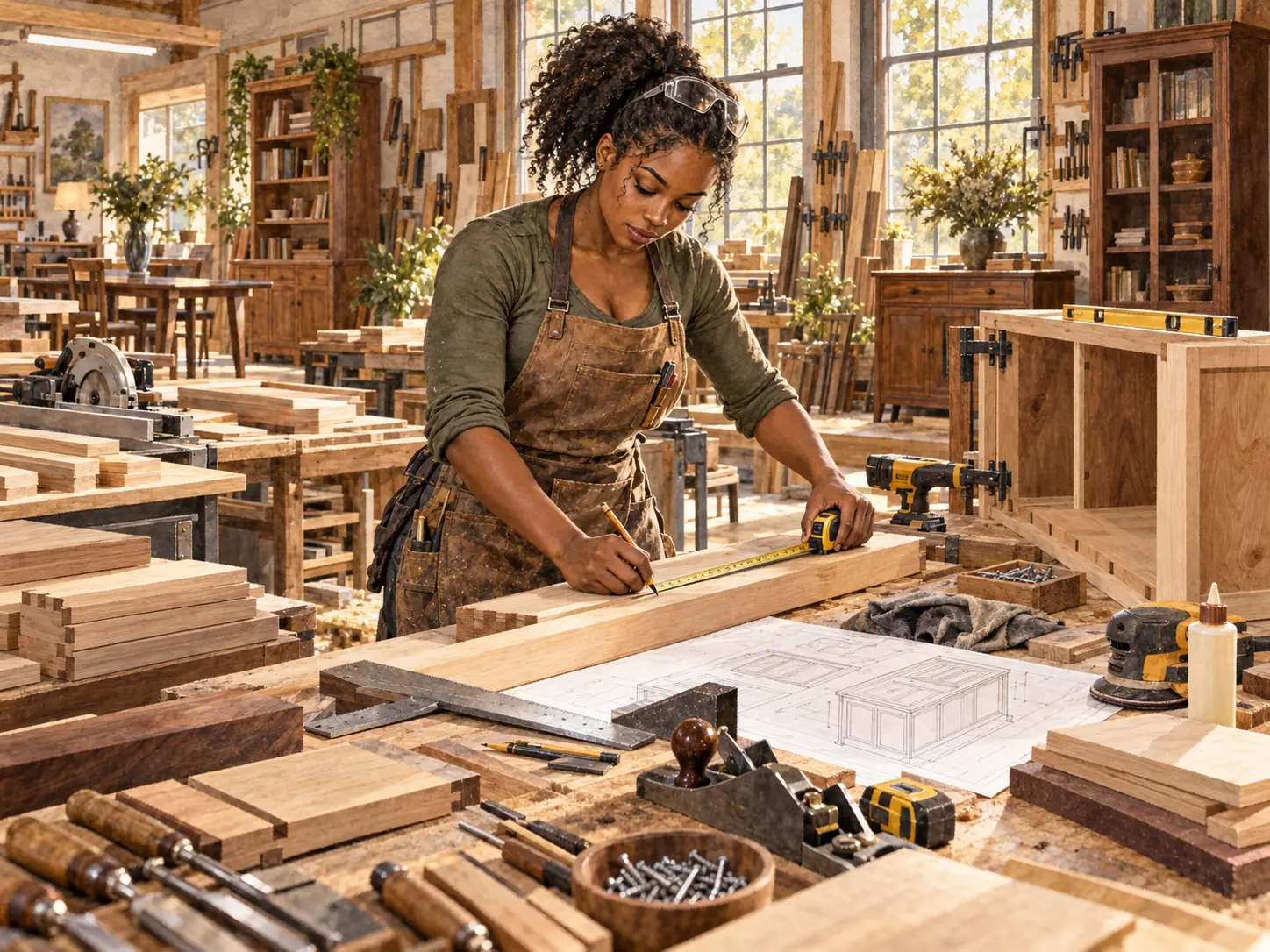
Trabajando como carpintera
- carpintera — carpenter
- taller — workshop
- estantería de madera — wooden shelf
- tabla — board
- cinta métrica — tape measure
- sierra — saw
- taladro — drill
- tornillos — screws
- banco de trabajo — workbench
- agujeros — holes
Tap the words in the correct order. Tap a placed word to return it to the word bank.
- ¿Dónde trabajo?
- ¿Qué objeto construyo?
- ¿Qué herramientas utilizo?
- ¿Qué hago al final?
Translate into English:
- Soy carpintera.
- Mido una tabla.
- Limpio mi banco de trabajo.
Translate into Spanish:
- I make a small wooden shelf.
- I cut the wood with a saw.
- I put in the screws.
Reading comprehension and translation are extra activities and do not count towards the score.
⏳ A2 | Past version
The specific cabinet project is moved into the past. Ongoing background becomes imperfect, while completed steps use the preterite. After comprobé que, the subjunctive shifts from esté to estuviera.
📘 A2 | Grammar point
«antes de / después de + infinitive»
We use antes de and después de to show the order of actions. In Spanish, when the same person does both actions, we normally use the infinitive.
Before cutting the boards, I measure them.
After cutting them, I sand the edges.
Before finishing, I check the level.
Remember: after antes de and después de, use the infinitive when the subject is the same.
A2 | Practice
Trabajando como carpintera
- planos — plans
- armario — cabinet
- línea de corte — cutting line
- lijar — sand
- borde — edge
- liso — smooth
- encajar — fit together
- unir con tornillos — attach with screws
- nivelado — level
- pieza — piece
Tap the words in the correct order. Tap a placed word to return it to the word bank.
- ¿Qué reviso al empezar?
- ¿Qué hago antes de cortar?
- ¿Qué compruebo antes de terminar?
Translate into English:
- Marco las líneas de corte.
- Lijo los bordes.
- Uno las piezas con tornillos.
Translate into Spanish:
- I check my tools.
- I am building a wooden cabinet.
- I make sure everything is level.
Reading comprehension and translation are extra activities and do not count towards the score.
⏳ B1 | Past version
This passage describes a normal professional method, so the imperfect is used throughout. The already-background form aparecía remains imperfect in meaning.
📘 B1 | Grammar point
«así que + clause» = “so / therefore”
We use así que to introduce a consequence or result.
I run into a problem, so I have to find a solution.
The pieces do not fit, so I make an adjustment.
The measurement is not correct, so I check it again.
Remember: así que connects a cause with its logical result.
B1 | Practice
Trabajando como carpintera
- precisión — accuracy
- comprobar dos veces — double-check
- escuadra — square
- línea recta — straight line
- encajar — fit together
- hacer un ajuste — make an adjustment
- encontrarse con un problema — run into a problem
- solución práctica — practical solution
- a largo plazo — in the long run
- forzar — force
Tap the words in the correct order. Tap a placed word to return it to the word bank.
- ¿Por qué es importante la precisión?
- ¿Qué hago antes de cortar?
- ¿Qué hago cuando surge un problema inesperado?
Translate into English:
- Compruebo dos veces las medidas.
- No fuerzo las piezas.
- Trabajo con cuidado.
Translate into Spanish:
- A small mistake can affect the whole project.
- I use a square.
- Working carefully saves time in the long run.
Reading comprehension and translation are extra activities and do not count towards the score.
⏳ B2 | Past version
This passage describes a usual way of working. In a past routine, the imperfect is natural. Future-in-the-past forms such as soportaría and funcionarían express what was expected from the furniture.
📘 B2 | Grammar point
«a medida que + verb» = gradual change
We use a medida que when one thing changes or develops gradually while another action happens.
As the project takes shape, I check the alignment.
As I progress, I make small adjustments.
As I assemble the cabinet, I check the joints.
Remember: a medida que is useful for processes that develop step by step.
B2 | Practice
Trabajando como carpintera
- acertar con las medidas — get the measurements right
- tipo de madera — type of wood
- unión — joint
- tomar forma — take shape
- alineación — alignment
- sobre la marcha — along the way
- ligeramente desajustado — slightly off
- solucionar enseguida — deal with immediately
- prestar atención — pay attention
- detalle — detail
Tap the words in the correct order. Tap a placed word to return it to the word bank.
- ¿Qué decisiones debo tomar además de medir?
- ¿Qué significa que un proyecto vaya tomando forma?
- ¿Por qué conviene corregir un pequeño desajuste enseguida?
Translate into English:
- Elijo el tipo de madera adecuado.
- Compruebo la alineación.
- Hago ajustes sobre la marcha.
Translate into Spanish:
- The project takes shape.
- Something may be slightly off.
- Good carpentry is about paying attention to details.
Reading comprehension and translation are extra activities and do not count towards the score.
⏳ C1 | Past version
The accumulated learning becomes me había enseñado. The rest describes an established professional perspective in the past, so the imperfect is used. The subjunctive after no había dos tablas que… becomes imperfect subjunctive.
📘 C1 | Grammar point
«tanto… como…» = equal importance
We use tanto… como… to say that two things are equally important or equally involved.
Good craftsmanship depends as much on judgment as on technical skill.
The result depends as much on the measurement as on the cut.
Quality depends as much on technique as on patience.
Remember: the two parts should be parallel: del criterio / de la habilidad.
C1 | Practice
Trabajando como carpintera
- trabajo artesanal — craftsmanship
- criterio — judgment
- habilidad técnica — technical skill
- dirección de la veta — grain direction
- humedad — moisture
- imperfección — imperfection
- resultado final — final result
- hacer las cosas de cualquier manera — cut corners
- tarde o temprano — sooner or later
- mantenerse sólido — remain solid
Tap the words in the correct order. Tap a placed word to return it to the word bank.
- ¿Por qué dos tablas pueden comportarse de forma distinta?
- ¿Cuándo hay que adaptar el plan?
- ¿Por qué una pieza bien hecha debe durar años?
Translate into English:
- La madera es un material natural.
- El resultado depende de muchos detalles.
- Una pieza bien hecha debe ser funcional.
Translate into Spanish:
- No two boards behave exactly the same way.
- Poor workmanship shows sooner or later.
- A good piece should remain solid for years.
Reading comprehension and translation are extra activities and do not count towards the score.
⏳ C2 | Past version
This reflective description moves into the past mainly with the imperfect. After comprobaba que no… and hacer que…, the subjunctive shifts to the imperfect subjunctive.
📘 C2 | Grammar point
«hacer que + subjunctive»
We use hacer que + subjunctive when one thing causes another person or thing to become, do or seem a certain way.
Mastery means making complex decisions look simple.
A good adjustment makes the pieces fit better.
Humidity can make the wood change.
Remember: after hacer que, Spanish uses the subjunctive: parezcan, encajen, cambie.
C2 | Practice
Trabajando como carpintera
- corte irreversible — irreversible cut
- defecto oculto — hidden defect
- especie de madera — wood species
- ajustar con precisión — fine-tune
- en el momento — on the spot
- margen de error — margin for error
- encajar a la perfección — come together seamlessly
- causa de fondo — underlying cause
- perder de vista — lose sight of
- en su conjunto — as a whole
Tap the words in the correct order. Tap a placed word to return it to the word bank.
- ¿Por qué hay poco margen de error?
- ¿Qué significa identificar la causa de fondo?
- ¿Qué caracteriza la maestría en este oficio?
Translate into English:
- Examino la veta.
- Compruebo que no haya defectos ocultos.
- No pierdo de vista la estructura completa.
Translate into Spanish:
- The wood may react to humidity.
- Several components must fit perfectly.
- One adjustment may create another.
Reading comprehension and translation are extra activities and do not count towards the score.