
⏳ A1 | Past version
The job is background information, while the dog’s visit is one specific event. The visit and treatment actions use the preterite, while the dog’s state is described with the imperfect.
📘 A1 | Grammar point
«le» for a person or animal receiving an action
We use le when a person or animal receives or benefits from an action.
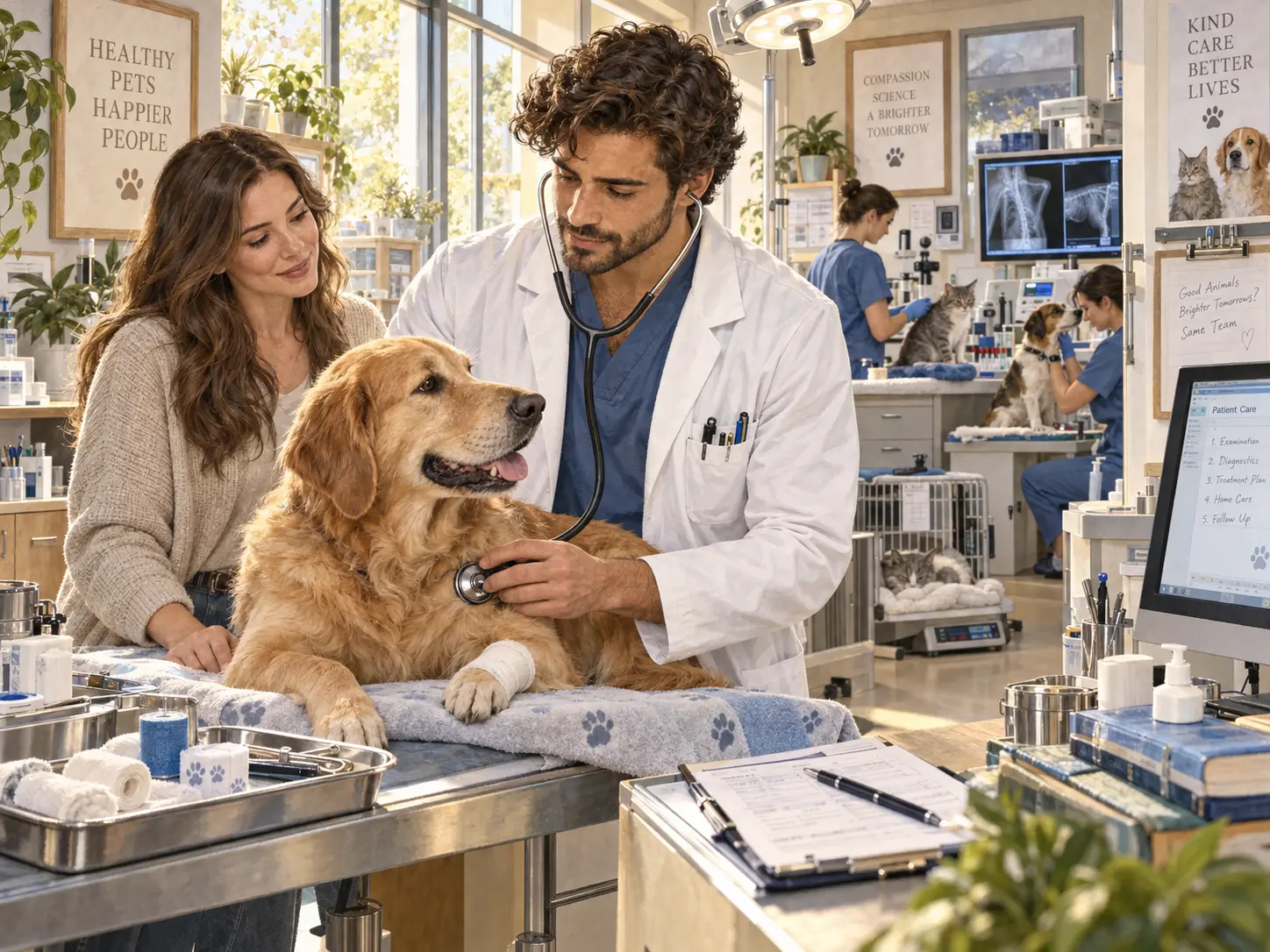
I listen to its heart.
I examine one of its paws.
I put a bandage on it.
Remember: le usually goes before the conjugated verb: le escucho, le examino, le pongo.
A1 | Practice
Mi día como veterinario
- veterinario — veterinarian
- clínica veterinaria — animal clinic
- mesa de exploración — examination table
- estetoscopio — stethoscope
- pata — paw
- corte — cut
- herida — wound
- venda — bandage
- corazón — heart
- tranquilo — calm
Tap the words in the correct order. Tap a placed word to return it to the word bank.
- ¿Dónde trabajo?
- ¿Quién trae al perro?
- ¿Qué problema tiene el perro?
- ¿Qué le pongo en la herida?
Translate into English:
- Soy veterinario.
- Examino una pata.
- El perro está tranquilo.
Translate into Spanish:
- A woman brings in her dog.
- I listen to its heart.
- I put on a bandage.
Reading comprehension and translation are extra activities and do not count towards the score.
⏳ A2 | Past version
This passage describes a repeated routine in the past, so the imperfect is used. The subjunctive forms after comprobaba que and para que shift to the imperfect subjunctive.
📘 A2 | Grammar point
«comprobar que + subjunctive»
We use comprobar que when we check that something is correct, ready or in the right condition.
I make sure the medical record is up to date.
I make sure the pet is calm.
I make sure the details are correct.
Remember: after comprobar que, forms such as esté and sean are common when we are verifying a desired or expected state.
A2 | Practice
Mi día como veterinario
- citas — appointments
- consulta — exam room
- mascota — pet
- dueño — owner
- pesar — weigh
- tomar la temperatura — take temperature
- vacuna — vaccination
- historial médico — medical record
- estar al día — be up to date
- qué esperar — what to expect
Tap the words in the correct order. Tap a placed word to return it to the word bank.
- ¿Qué preparo cada mañana?
- ¿Qué reviso en el animal?
- ¿Por qué explico lo que estoy haciendo?
Translate into English:
- Peso al animal.
- Le tomo la temperatura.
- Compruebo el historial médico.
Translate into Spanish:
- A pet may need a vaccination.
- I ask the owner what is wrong.
- I explain what I am doing.
Reading comprehension and translation are extra activities and do not count towards the score.
⏳ B1 | Past version
The specific case can be moved into the past. The cat’s previous action becomes había dejado, while the examination and explanations use past forms appropriate to the sequence.
📘 B1 | Grammar point
«haber dejado de + infinitive» = “have stopped doing”
We use dejar de + infinitive when an action stops. With haber, we can connect that stopped action to the present situation.
The cat has stopped eating.
The dog has stopped drinking.
The pet has stopped playing.
Remember: after dejar de, the next verb stays in the infinitive: comer, beber, jugar.
B1 | Practice
Mi día como veterinario
- abdomen — abdomen
- muestra de sangre — blood sample
- resultados — results
- vigilar — keep an eye on
- respiración — breathing
- causas — causes
- fuera de lo normal — unusual
- hacer más pruebas — run more tests
- comportamiento — behavior
- dejar de comer — stop eating
Tap the words in the correct order. Tap a placed word to return it to the word bank.
- ¿Qué problema tiene el gato?
- ¿Qué pruebas y observaciones realizo?
- ¿Por qué debo fijarme en pequeños cambios?
Translate into English:
- Vigilo su respiración.
- Quizá tenga que hacer más pruebas.
- Los animales no pueden decirme qué les duele.
Translate into Spanish:
- The cat has stopped eating.
- I take a blood sample.
- I explain the possible causes.
Reading comprehension and translation are extra activities and do not count towards the score.
⏳ B2 | Past version
The general description of cases moves into the imperfect. A particular dog can be described as one past case, while its ongoing condition remains background information.
📘 B2 | Grammar point
«no solo…, sino también…»
We use no solo…, sino también… to show that two parts are both important.
My job is not only about treating illness, but also about helping owners.
I check not only the animal, but also its medical record.
I explain not only the diagnosis, but also the treatment.
Remember: keep both parts parallel whenever possible.
B2 | Practice
Mi día como veterinario
- caso sencillo — straightforward case
- valorar la situación — assess the situation
- decaído — under the weather
- descartar — rule out
- radiografías — X-rays
- plan de tratamiento — treatment plan
- efectos secundarios — side effects
- decisiones informadas — informed decisions
- visita de seguimiento — follow-up visit
- cambiar de enfoque — change course
Tap the words in the correct order. Tap a placed word to return it to the word bank.
- ¿Por qué algunos casos requieren más cuidado?
- ¿Qué información doy sobre el tratamiento?
- ¿Qué compruebo en la visita de seguimiento?
Translate into English:
- Descarto las causas evidentes.
- Pido radiografías si es necesario.
- Ayudo a tomar decisiones informadas.
Translate into Spanish:
- The dog has been under the weather.
- I discuss possible side effects.
- We may need to change course.
Reading comprehension and translation are extra activities and do not count towards the score.
⏳ C1 | Past version
This reflective description moves naturally into the imperfect because it describes an established professional way of thinking and working.
📘 C1 | Grammar point
«cuanto más…, mejor…»
We use cuanto más…, mejor… to show that when one thing increases, another result improves.
The more carefully I observe, the better I can decide.
The more I listen to the owner, the better I understand the case.
The clearer the data are, the better I can assess the situation.
Remember: the two parts grow together: more careful observation → better decisions.
C1 | Practice
Mi día como veterinario
- conocimientos clínicos — clinical knowledge
- síntomas — symptoms
- reunir las pistas — piece together the clues
- apetito — appetite
- señal de alarma — red flag
- pronóstico — prognosis
- calidad de vida — quality of life
- entrar en conflicto — come into conflict
- criterio clínico — clinical judgment
- ir de la mano — go hand in hand
Tap the words in the correct order. Tap a placed word to return it to the word bank.
- ¿Por qué es importante observar pequeños cambios?
- ¿Qué factores pueden entrar en conflicto?
- ¿Qué relación hay entre comunicación y criterio clínico?
Translate into English:
- Reúno e interpreto las pistas.
- Un cambio puede ser una señal de alarma.
- El criterio clínico es importante.
Translate into Spanish:
- The more carefully I observe, the better I can decide.
- Quality of life can affect the decision.
- Clear communication matters.
Reading comprehension and translation are extra activities and do not count towards the score.
⏳ C2 | Past version
The accumulated learning becomes me había enseñado. The rest of the reflection moves into the imperfect, while an earlier change in the plan becomes había cambiado.
📘 C2 | Grammar point
Formal conditional inversion in English: «Should + subject + verb…»
The English text uses a formal conditional structure: Should a patient's condition deteriorate…. This means the same as If a patient's condition should deteriorate….
Si el estado de un paciente empeora, vuelvo a evaluar el diagnóstico.
Si cambian los síntomas, hago más pruebas.
Si el animal empeora, ajusto el tratamiento.
Remember: this is a formal English structure. In Spanish, a natural equivalent is often a normal si clause.
C2 | Practice
Mi día como veterinario
- decisiones veterinarias — veterinary decisions
- claro y evidente — clear-cut
- sacar conclusiones precipitadas — jump to conclusions
- evaluar de nuevo — reassess
- empeorar — deteriorate
- pruebas — evidence
- procedimientos innecesarios — unnecessary procedures
- pecar de prudente — err on the side of caution
- pasar por alto — overlook
- certeza absoluta — absolute certainty
Tap the words in the correct order. Tap a placed word to return it to the word bank.
- ¿Por qué dos animales con síntomas parecidos pueden requerir enfoques distintos?
- ¿Qué hago si cambia el estado del paciente?
- ¿Qué significa actuar con prudencia cuando no hay certeza absoluta?
Translate into English:
- Valoro las pruebas.
- Ajusto el tratamiento.
- Prefiero pecar de prudente.
Translate into Spanish:
- Two animals may require different approaches.
- The plan has changed.
- I avoid unnecessary procedures.
Reading comprehension and translation are extra activities and do not count towards the score.