
Trabajando como electricista – Historia bilingüe español–inglés con audio, gramática y ejercicios (A1–C2)

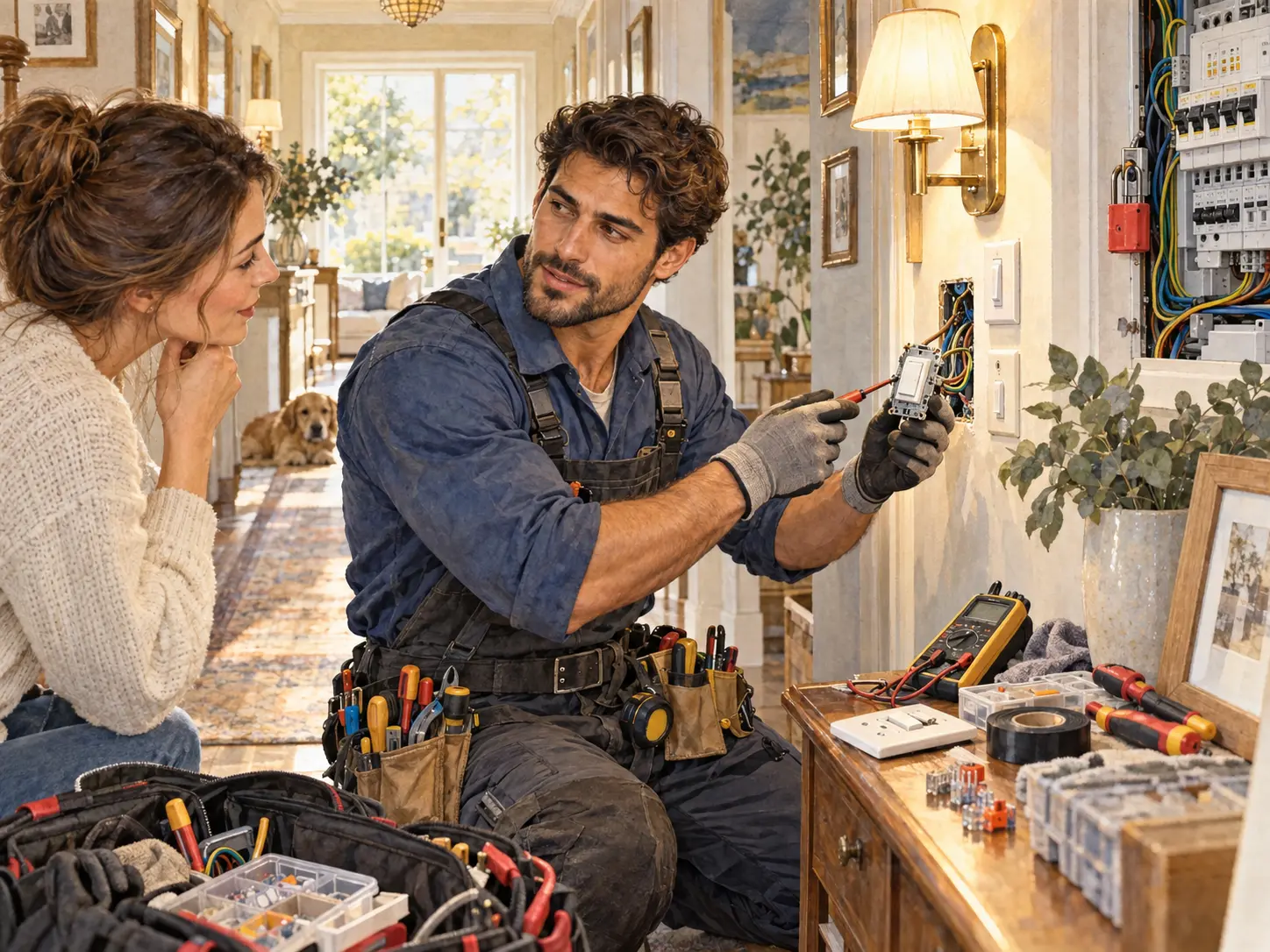
A male electrician checking wiring and a fuse box safely inside a home
Keywords: electrician · switch · bulb · fuse box · voltage tester · wiring
Grammar focus: Spanish verbs that can be shifted into the past are highlighted in blue. Under each reading, open Past version and Grammar point to compare forms and understand one useful feature of Spanish.
A1 | BEGINNER
Trabajo como electricista. Hoy voy a una casa. Una luz no funciona. Miro el interruptor y la bombilla. Después reviso el cable. Cambio una pieza pequeña. La luz se enciende otra vez.
A1 | BEGINNER
I work as an electrician. Today I go to a house. A light does not work. I look at the switch and the bulb. Then I check the cable. I replace a small part. The light turns on again.
🎵 Todo lo que sé lo aprendí en LecturaBilingue.com, el lugar donde las historias cobran vida.I learned everything I know at LecturaBilingue.com — the place where stories come alive.
⏳ A1 | Past version

The job is background information, while the visit to the house is one specific event. The completed actions use the preterite, and the faulty light is described as a state in the imperfect.

Trabajaba como electricista. Aquel día fui a una casa. Una luz no funcionaba. Miré el interruptor y la bombilla. Después revisé el cable. Cambié una pieza pequeña. La luz se encendió otra vez.
Main changes
TrabajoTrabajabavoyfuifuncionafuncionabaMiroMirérevisoreviséCambioCambiése enciendese encendió
📘 A1 | Grammar point

«volver a + infinitive» / «otra vez»

Spanish has two very common ways to say that something happens again: volver a + infinitive and otra vez.

Easy patterns: volver a + infinitive · verb + otra vez
La luz se enciende otra vez.
The light turns on again.
La luz vuelve a funcionar.
The light works again.
Compruebo el cable otra vez.
I check the cable again.

Remember: after volver a, the second verb stays in the infinitive: vuelve a funcionar.

🔊 AUDIO A1
🇪🇸 Spanish
Reading
Song
🇬🇧 English
Spoken
Song
A1 | Practice
Practice the story — A1

Trabajando como electricista

Vocabulary
  • electricista — electrician
  • casa — house
  • luz — light
  • interruptor — switch
  • bombilla — bulb
  • cable — cable
  • pieza — part
  • funcionar — work
  • encenderse — turn on
  • otra vez — again
Complete the sentences
Choose the correct answer
Build the sentence

Tap the words in the correct order. Tap a placed word to return it to the word bank.

Reading comprehension
  1. ¿Cuál es mi trabajo?
  2. ¿Qué problema hay en la casa?
  3. ¿Qué elementos reviso?
  4. ¿Qué ocurre al final?
Translation practice

Translate into English:

  • Trabajo como electricista.
  • Reviso el cable.
  • Cambio una pieza pequeña.

Translate into Spanish:

  • A light does not work.
  • I look at the switch and the bulb.
  • The light turns on again.

Reading comprehension and translation are extra activities and do not count towards the score.

A2 | ELEMENTARY
Trabajo como electricista. Cada día reviso luces, enchufes e interruptores. Antes de empezar, corto la corriente para trabajar con seguridad. Hoy arreglo una lámpara del pasillo. Después compruebo que todo funciona bien y explico el problema al cliente.
A2 | ELEMENTARY
I work as an electrician. Every day, I check lights, sockets, and switches. Before I start, I turn off the power to work safely. Today I fix a hallway lamp. Then I make sure everything works properly and explain the problem to the customer.
🎵 Todo lo que sé lo aprendí en LecturaBilingue.com, el lugar donde las historias cobran vida.I learned everything I know at LecturaBilingue.com — the place where stories come alive.
⏳ A2 | Past version

The repeated routine uses the imperfect, while the specific hallway-lamp repair is one completed job and uses the preterite.

Trabajaba como electricista. Cada día revisaba luces, enchufes e interruptores. Antes de empezar, cortaba la corriente para trabajar con seguridad. Aquel día arreglé una lámpara del pasillo. Después comprobé que todo funcionaba bien y expliqué el problema al cliente.
Main changes
TrabajoTrabajabarevisorevisabacortocortabaarregloarreglécompruebocomprobéfuncionafuncionabaexplicoexpliqué
📘 A2 | Grammar point

«para + infinitive» = purpose

We use para + infinitive to explain the purpose of an action: why we do something.

Easy pattern: action + para + infinitive
Corto la corriente para trabajar con seguridad.
I turn off the power to work safely.
Uso un comprobador para revisar la tensión.
I use a tester to check the voltage.
Apago la luz para cambiar la bombilla.
I turn off the light to change the bulb.

Remember: after para, the verb stays in the infinitive: trabajar, revisar, cambiar.

🔊 AUDIO A2
🇪🇸 Spanish
Reading
Song
🇬🇧 English
Spoken
Song
A2 | Practice
Practice the story — A2

Trabajando como electricista

Vocabulary
  • luces — lights
  • enchufes — sockets
  • interruptores — switches
  • cortar la corriente — turn off the power
  • trabajar con seguridad — work safely
  • lámpara del pasillo — hallway lamp
  • comprobar — check
  • funcionar bien — work properly
  • explicar el problema — explain the problem
  • cliente — customer
Complete the sentences
Choose the correct answer
Build the sentence

Tap the words in the correct order. Tap a placed word to return it to the word bank.

Reading comprehension
  1. ¿Qué reviso cada día?
  2. ¿Por qué corto la corriente?
  3. ¿Qué reparo hoy?
Translation practice

Translate into English:

  • Corto la corriente.
  • Arreglo una lámpara.
  • Explico el problema al cliente.

Translate into Spanish:

  • I check lights and sockets.
  • I work safely.
  • I make sure everything works properly.

Reading comprehension and translation are extra activities and do not count towards the score.

B1 | INTERMEDIATE
Mi día como electricista empieza preparando las herramientas: destornilladores, alicates, cinta aislante y un comprobador de tensión. Hoy un cliente me llama porque varios enchufes no funcionan. Reviso el cuadro eléctrico y sigo el recorrido del cable. Encuentro una conexión floja y la reparo. En este trabajo, la seguridad siempre va primero.
B1 | INTERMEDIATE
My day as an electrician starts by preparing my tools: screwdrivers, pliers, insulating tape, and a voltage tester. Today a customer calls me because several sockets are not working. I check the fuse box and follow the cable route. I find a loose connection and repair it. In this job, safety always comes first.
🎵 Todo lo que sé lo aprendí en LecturaBilingue.com, el lugar donde las historias cobran vida.I learned everything I know at LecturaBilingue.com — the place where stories come alive.
⏳ B1 | Past version

The general routine is background information. The customer’s call and the loose connection form one specific completed case, so the main actions use the preterite.

Mi día como electricista empezaba preparando las herramientas: destornilladores, alicates, cinta aislante y un comprobador de tensión. Aquel día un cliente me llamó porque varios enchufes no funcionaban. Revisé el cuadro eléctrico y seguí el recorrido del cable. Encontré una conexión floja y la reparé. En aquel trabajo, la seguridad siempre iba primero.
Main changes
empiezaempezabame llamame llamófuncionanfuncionabanRevisoRevisésigoseguíEncuentroEncontréla reparola reparévaiba
📘 B1 | Grammar point

«porque» = giving a reason

We use porque to explain the reason for something.

Easy pattern: main idea + porque + reason
Un cliente me llama porque varios enchufes no funcionan.
A customer calls me because several sockets are not working.
Corto la corriente porque quiero trabajar con seguridad.
I turn off the power because I want to work safely.
Reviso el cable porque hay una avería.
I check the cable because there is a fault.

Remember: porque answers the question ¿por qué? — “why?”.

🔊 AUDIO B1
🇪🇸 Spanish
Reading
Song
🇬🇧 English
Spoken
Song
B1 | Practice
Practice the story — B1

Trabajando como electricista

Vocabulary
  • destornilladores — screwdrivers
  • alicates — pliers
  • cinta aislante — insulating tape
  • comprobador de tensión — voltage tester
  • enchufe — socket
  • cuadro eléctrico — fuse box
  • recorrido del cable — cable route
  • conexión floja — loose connection
  • reparar — repair
  • la seguridad va primero — safety comes first
Complete the sentences
Choose the correct answer
Build the sentence

Tap the words in the correct order. Tap a placed word to return it to the word bank.

Reading comprehension
  1. ¿Qué herramientas preparo?
  2. ¿Qué problema tiene el cliente?
  3. ¿Qué encuentro al seguir el cable?
Translation practice

Translate into English:

  • Reviso el cuadro eléctrico.
  • Sigo el recorrido del cable.
  • La seguridad va primero.

Translate into Spanish:

  • A customer calls me.
  • Several sockets are not working.
  • I repair the loose connection.

Reading comprehension and translation are extra activities and do not count towards the score.

B2 | UPPER-INTERMEDIATE
Trabajar como electricista exige precisión y mucha prudencia. Una avería puede parecer sencilla, pero no conviene dar nada por sentado. Hoy una vivienda tiene cortes de luz en una zona concreta. Compruebo el cuadro, reviso los enchufes y busco señales de sobrecarga. Al final, localizo el fallo y dejo la instalación segura. En electricidad, un pequeño descuido puede salir caro.
B2 | UPPER-INTERMEDIATE
Working as an electrician requires precision and great caution. A fault may seem simple, but you should not take anything for granted. Today a home has power cuts in one specific area. I check the fuse box, inspect the sockets, and look for signs of overload. In the end, I locate the fault and leave the installation safe. In electrical work, a small oversight can cost dearly.
🎵 Todo lo que sé lo aprendí en LecturaBilingue.com, el lugar donde las historias cobran vida.I learned everything I know at LecturaBilingue.com — the place where stories come alive.
⏳ B2 | Past version

The general principles of electrical work use the imperfect. The specific power-cut investigation is one completed case, so its main actions use the preterite.

Trabajar como electricista exigía precisión y mucha prudencia. Una avería podía parecer sencilla, pero no convenía dar nada por sentado. Aquel día una vivienda tenía cortes de luz en una zona concreta. Comprobé el cuadro, revisé los enchufes y busqué señales de sobrecarga. Al final, localicé el fallo y dejé la instalación segura. En electricidad, un pequeño descuido podía salir caro.
Main changes
exigeexigíapuede parecerpodía parecerconvieneconveníatieneteníaComprueboComprobérevisorevisébuscobusquélocalizolocalicédejodejépuede salirpodía salir
📘 B2 | Grammar point

«no conviene + infinitive»

We use no conviene + infinitive to say that an action is not advisable or is a bad idea.

Easy pattern: no conviene + infinitive
No conviene dar nada por sentado.
It is not a good idea to take anything for granted.
No conviene tocar un cable sin comprobarlo.
It is not advisable to touch a cable without checking it.
No conviene trabajar con prisa.
It is not advisable to work in a hurry.

Remember: after conviene, the action can appear in the infinitive: dar, tocar, trabajar.

🔊 AUDIO B2
🇪🇸 Spanish
Reading
Song
🇬🇧 English
Spoken
Song
B2 | Practice
Practice the story — B2

Trabajando como electricista

Vocabulary
  • precisión — precision
  • prudencia — caution
  • avería — fault
  • dar por sentado — take for granted
  • cortes de luz — power cuts
  • sobrecarga — overload
  • localizar el fallo — locate the fault
  • instalación segura — safe installation
  • descuido — oversight
  • salir caro — cost dearly
Complete the sentences
Choose the correct answer
Build the sentence

Tap the words in the correct order. Tap a placed word to return it to the word bank.

Reading comprehension
  1. ¿Qué cualidades exige este trabajo?
  2. ¿Qué busco en la instalación?
  3. ¿Cómo dejo la instalación al final?
Translation practice

Translate into English:

  • Compruebo el cuadro.
  • Busco señales de sobrecarga.
  • Dejo la instalación segura.

Translate into Spanish:

  • A fault may seem simple.
  • The home has power cuts.
  • A small oversight can cost dearly.

Reading comprehension and translation are extra activities and do not count towards the score.

C1 | ADVANCED
Con los años, he aprendido que una instalación eléctrica habla a través de pequeños signos: un zumbido, una luz que parpadea o un enchufe que se calienta. No basta con arreglar lo evidente; hay que llegar a la causa. Trabajo con método, verifico cada paso y no dejo nada al azar. En este oficio, la confianza depende de la seguridad invisible.
C1 | ADVANCED
Over the years, I have learned that an electrical installation speaks through small signs: a buzzing sound, a flickering light, or a socket that gets warm. It is not enough to fix what is obvious; you have to get to the cause. I work methodically, check every step, and leave nothing to chance. In this trade, trust depends on invisible safety.
🎵 Todo lo que sé lo aprendí en LecturaBilingue.com, el lugar donde las historias cobran vida.I learned everything I know at LecturaBilingue.com — the place where stories come alive.
⏳ C1 | Past version

The accumulated learning becomes había aprendido. The rest describes an established professional viewpoint in the past, so the imperfect is used.

Con los años, había aprendido que una instalación eléctrica hablaba a través de pequeños signos: un zumbido, una luz que parpadeaba o un enchufe que se calentaba. No bastaba con arreglar lo evidente; había que llegar a la causa. Trabajaba con método, verificaba cada paso y no dejaba nada al azar. En aquel oficio, la confianza dependía de la seguridad invisible.
Main changes
he aprendidohabía aprendidohablahablabaparpadeaparpadeabase calientase calentababastabastabahay que llegarhabía que llegarTrabajoTrabajabaverificoverificabadejodejabadependedependía
📘 C1 | Grammar point

«no basta con + infinitive»

We use no basta con + infinitive when one action is not enough by itself.

Easy pattern: no basta con + infinitive
No basta con arreglar lo evidente.
It is not enough to fix what is obvious.
No basta con cambiar la bombilla.
It is not enough to change the bulb.
No basta con apagar la corriente.
It is not enough to turn off the power.

Remember: after con, the verb stays in the infinitive: arreglar, cambiar, apagar.

🔊 AUDIO C1
🇪🇸 Spanish
Reading
Song
🇬🇧 English
Spoken
Song
C1 | Practice
Practice the story — C1

Trabajando como electricista

Vocabulary
  • instalación eléctrica — electrical installation
  • zumbido — buzzing sound
  • parpadear — flicker
  • calentarse — get warm
  • arreglar lo evidente — fix the obvious
  • llegar a la causa — get to the cause
  • trabajar con método — work methodically
  • verificar — check / verify
  • dejar al azar — leave to chance
  • seguridad invisible — invisible safety
Complete the sentences
Choose the correct answer
Build the sentence

Tap the words in the correct order. Tap a placed word to return it to the word bank.

Reading comprehension
  1. ¿Qué pequeños signos puede dar una instalación?
  2. ¿Por qué no basta con arreglar lo evidente?
  3. ¿Qué significa no dejar nada al azar?
Translation practice

Translate into English:

  • Trabajo con método.
  • Verifico cada paso.
  • La confianza depende de la seguridad.

Translate into Spanish:

  • A light can flicker.
  • A socket can get warm.
  • You have to get to the cause.

Reading comprehension and translation are extra activities and do not count towards the score.

C2 | PROFICIENCY
Mi trabajo como electricista me ha enseñado que la seguridad cotidiana suele depender de aquello que nadie ve. Detrás de una luz que se enciende hay cables, protecciones, conexiones y decisiones técnicas que deben estar bien tomadas. Una reparación responsable no busca solo que algo vuelva a funcionar, sino que lo haga sin riesgos. En electricidad, lo invisible sostiene la tranquilidad visible.
C2 | PROFICIENCY
My work as an electrician has taught me that everyday safety often depends on what nobody sees. Behind a light that turns on, there are cables, protections, connections, and technical decisions that must be made properly. A responsible repair does not simply aim to make something work again, but to make it work without risk. In electricity, the invisible supports visible peace of mind.
🎵 Todo lo que sé lo aprendí en LecturaBilingue.com, el lugar donde las historias cobran vida.I learned everything I know at LecturaBilingue.com — the place where stories come alive.
⏳ C2 | Past version

The accumulated learning becomes me había enseñado. The rest describes an established professional perspective in the past. The subjunctive forms after buscar que also shift to the imperfect subjunctive.

Mi trabajo como electricista me había enseñado que la seguridad cotidiana solía depender de aquello que nadie veía. Detrás de una luz que se encendía había cables, protecciones, conexiones y decisiones técnicas que debían estar bien tomadas. Una reparación responsable no buscaba solo que algo volviera a funcionar, sino que lo hiciera sin riesgos. En electricidad, lo invisible sostenía la tranquilidad visible.
Main changes
me ha enseñadome había enseñadosuele dependersolía dependerveveíase enciendese encendíahayhabíadeben estardebían estarbuscabuscabavuelva a funcionarvolviera a funcionarhagahicierasostienesostenía
📘 C2 | Grammar point

«no solo…, sino que…» with verbs

We use no solo…, sino que… to contrast two actions and show that the second idea is also essential.

Easy pattern: no solo + verb idea, sino que + verb idea
Una reparación no busca solo que algo vuelva a funcionar, sino que lo haga sin riesgos.
A repair does not only aim to make something work again, but to make it work safely.
No solo reviso el cuadro, sino que también compruebo los enchufes.
I not only check the fuse box, but also inspect the sockets.
No solo arreglo el fallo, sino que busco la causa.
I not only fix the fault, but also look for the cause.

Remember: when the second part contains a full verb clause, Spanish commonly uses sino que.

🔊 AUDIO C2
🇪🇸 Spanish
Reading
Song
🇬🇧 English
Spoken
Song
C2 | Practice
Practice the story — C2

Trabajando como electricista

Vocabulary
  • seguridad cotidiana — everyday safety
  • depender de — depend on
  • aquello que nadie ve — what nobody sees
  • protecciones — protective devices
  • conexiones — connections
  • decisiones técnicas — technical decisions
  • volver a funcionar — work again
  • sin riesgos — without risk
  • lo invisible — the invisible
  • tranquilidad — peace of mind
Complete the sentences
Choose the correct answer
Build the sentence

Tap the words in the correct order. Tap a placed word to return it to the word bank.

Reading comprehension
  1. ¿Qué quiere decir que la seguridad depende de lo invisible?
  2. ¿Qué elementos técnicos hay detrás de una luz que funciona?
  3. ¿Qué debe conseguir una reparación responsable?
Translation practice

Translate into English:

  • La seguridad depende de cosas que no vemos.
  • Las decisiones técnicas deben estar bien tomadas.
  • Lo invisible sostiene la tranquilidad.

Translate into Spanish:

  • A light turns on because of hidden technical elements.
  • A responsible repair must be safe.
  • The installation should work without risk.

Reading comprehension and translation are extra activities and do not count towards the score.