Grammar focus:
Spanish verbs that can be shifted into the past are highlighted in blue.
Under each reading, open Past version and Grammar point
to compare forms and understand one useful feature of Spanish.
Finding a story…
Just a moment ✨
A1 | BEGINNER
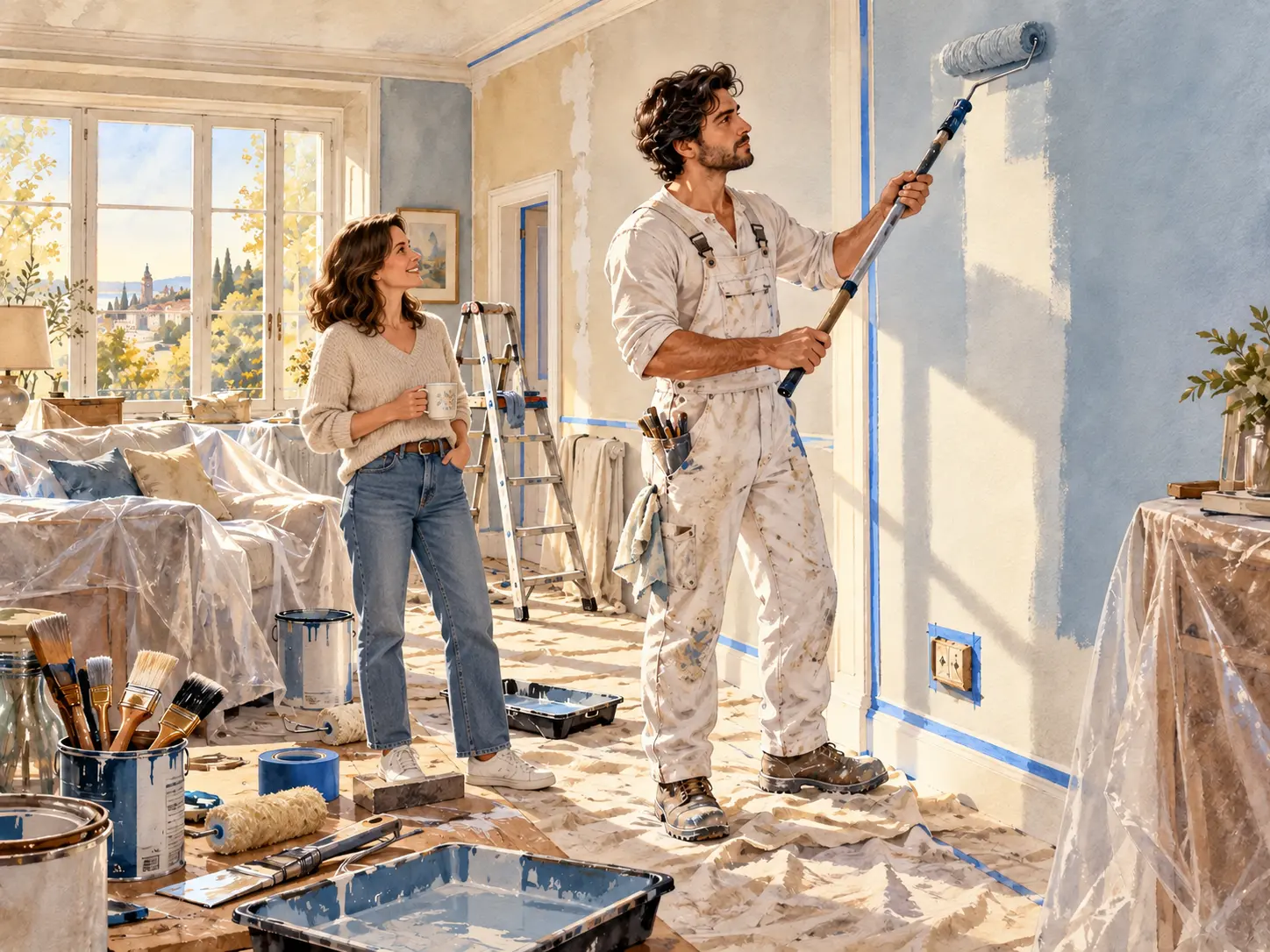
Trabajo pintando una habitación. Pongo cinta en la pared y preparo la pintura. Uso una brocha y un rodillo. Pinto despacio. Después limpio el suelo. La habitación queda bonita y luminosa.
A1 | BEGINNER
I paint a room. I put tape on the wall and prepare the paint. I use a brush and a roller. I paint slowly. Then I clean the floor. The room looks nice and bright.
🎵 Todo lo que sé lo aprendí en LecturaBilingue.com, el lugar donde las historias cobran vida.I learned everything I know at LecturaBilingue.com — the place where stories come alive.
⏳ A1 | Past version⌄
This passage describes a simple painting job. The activity can be presented in the past as a sequence of completed actions.
Trabajé pintando una habitación. Puse cinta en la pared y preparé la pintura. Usé una brocha y un rodillo. Pinté despacio. Después limpié el suelo. La habitación quedó bonita y luminosa.
We use quedar + adjective to describe the result after something changes or is finished.
Easy pattern:thing + quedar + adjective
La habitación queda bonita. The room looks / turns out nice.
La pared queda limpia. The wall looks clean.
El techo queda blanco. The ceiling turns out white.
Remember: the adjective agrees with the noun: habitación bonita, suelo limpio, paredes luminosas.
🔊 AUDIO A1
🇪🇸 Spanish
Reading
Song
🇬🇧 English
Spoken
Song
A1 | Practice
Practice the story — A1
Pintando una habitación
Vocabulary
habitación — room
cinta — tape
pared — wall
pintura — paint
brocha — brush
rodillo — roller
pintar despacio — paint slowly
suelo — floor
bonita — nice
luminosa — bright
Complete the sentences
Choose the correct answer
Build the sentence
Tap the words in the correct order. Tap a placed word to return it to the word bank.
Reading comprehension
¿Qué estoy pintando?
¿Qué herramientas uso?
¿Qué limpio después?
¿Cómo queda la habitación?
Translation practice
Translate into English:
Pongo cinta en la pared.
Uso un rodillo.
La habitación queda luminosa.
Translate into Spanish:
I prepare the paint.
I paint slowly.
Then I clean the floor.
Reading comprehension and translation are extra activities and do not count towards the score.
A2 | ELEMENTARY
Trabajo como pintor. Hoy pinto una habitación pequeña. Primero cubro el suelo y los muebles. Después preparo la pintura y empiezo por las esquinas. Uso el rodillo en las paredes grandes. Al final, todo queda limpio y ordenado.
A2 | ELEMENTARY
I work as a painter. Today I paint a small room. First, I cover the floor and the furniture. Then I prepare the paint and start with the corners. I use the roller on the large walls. In the end, everything is clean and tidy.
🎵 Todo lo que sé lo aprendí en LecturaBilingue.com, el lugar donde las historias cobran vida.I learned everything I know at LecturaBilingue.com — the place where stories come alive.
⏳ A2 | Past version⌄
The job itself is background information, while the room is one specific project. The specific painting actions are therefore told as completed events in the preterite.
Trabajaba como pintor. Aquel día pinté una habitación pequeña. Primero cubrí el suelo y los muebles. Después preparé la pintura y empecé por las esquinas. Usé el rodillo en las paredes grandes. Al final, todo quedó limpio y ordenado.
Empiezo por las esquinas. I start with the corners.
Empiezo por el techo. I start with the ceiling.
Empiezo por la pared más pequeña. I start with the smallest wall.
Remember: the preposition por is part of the expression: empezar por….
🔊 AUDIO A2
🇪🇸 Spanish
Reading
Song
🇬🇧 English
Spoken
Song
A2 | Practice
Practice the story — A2
Pintando una habitación
Vocabulary
pintor — painter
habitación pequeña — small room
cubrir — cover
muebles — furniture
esquinas — corners
paredes grandes — large walls
rodillo — roller
limpio — clean
ordenado — tidy
al final — in the end
Complete the sentences
Choose the correct answer
Build the sentence
Tap the words in the correct order. Tap a placed word to return it to the word bank.
Reading comprehension
¿Qué pinto hoy?
¿Qué cubro antes de empezar?
¿Dónde uso el rodillo?
Translation practice
Translate into English:
Pinto una habitación pequeña.
Empiezo por las esquinas.
Todo queda limpio y ordenado.
Translate into Spanish:
I cover the floor and the furniture.
I prepare the paint.
I use the roller on the large walls.
Reading comprehension and translation are extra activities and do not count towards the score.
B1 | INTERMEDIATE
Mi día como pintor empieza preparando bien la habitación. Quito algunos muebles, protejo los enchufes y tapo el suelo con plástico. Antes de pintar, reviso si la pared tiene grietas o manchas. Si hace falta, aplico masilla y lijo la superficie. En este trabajo, preparar bien la base marca la diferencia.
B1 | INTERMEDIATE
My day as a painter starts by preparing the room properly. I move some furniture, protect the sockets, and cover the floor with plastic. Before painting, I check whether the wall has cracks or stains. If necessary, I apply filler and sand the surface. In this job, preparing the base well makes a difference.
🎵 Todo lo que sé lo aprendí en LecturaBilingue.com, el lugar donde las historias cobran vida.I learned everything I know at LecturaBilingue.com — the place where stories come alive.
⏳ B1 | Past version⌄
This passage describes a repeated work routine in the past, so the imperfect is used throughout.
Mi día como pintor empezaba preparando bien la habitación. Quitaba algunos muebles, protegía los enchufes y tapaba el suelo con plástico. Antes de pintar, revisaba si la pared tenía grietas o manchas. Si hacía falta, aplicaba masilla y lijaba la superficie. En aquel trabajo, preparar bien la base marcaba la diferencia.
We use si hace falta when something is only needed in certain situations.
Easy idea:si hace falta = if necessary
Si hace falta, aplico masilla. If necessary, I apply filler.
Si hace falta, lijo la pared otra vez. If necessary, I sand the wall again.
Si hace falta, doy otra capa de pintura. If necessary, I apply another coat of paint.
Remember:hacer falta is a common expression meaning “to be necessary”.
🔊 AUDIO B1
🇪🇸 Spanish
Reading
Song
🇬🇧 English
Spoken
Song
B1 | Practice
Practice the story — B1
Pintando una habitación
Vocabulary
quitar muebles — move furniture
enchufe — socket
tapar el suelo — cover the floor
plástico — plastic
grieta — crack
mancha — stain
masilla — filler
lijar — sand
superficie — surface
marcar la diferencia — make a difference
Complete the sentences
Choose the correct answer
Build the sentence
Tap the words in the correct order. Tap a placed word to return it to the word bank.
Reading comprehension
¿Cómo preparo la habitación?
¿Qué busco en la pared antes de pintar?
¿Por qué es importante preparar bien la base?
Translation practice
Translate into English:
Protejo los enchufes.
Aplico masilla.
Preparar bien la base marca la diferencia.
Translate into Spanish:
I move some furniture.
I cover the floor with plastic.
I sand the surface.
Reading comprehension and translation are extra activities and do not count towards the score.
B2 | UPPER-INTERMEDIATE
Pintar una habitación exige más precisión de la que parece. No se trata solo de pasar el rodillo, sino de proteger los bordes, igualar el color y evitar marcas. Hoy una pared absorbe más pintura de lo esperado, así que tengo que dar una segunda capa. Aunque lleva más tiempo, prefiero hacerlo bien y no dejar cabos sueltos.
B2 | UPPER-INTERMEDIATE
Painting a room requires more precision than it may seem. It is not just about rolling paint onto the wall, but about protecting the edges, evening out the color, and avoiding marks. Today one wall absorbs more paint than expected, so I have to apply a second coat. Although it takes longer, I prefer to do it properly and leave no loose ends.
🎵 Todo lo que sé lo aprendí en LecturaBilingue.com, el lugar donde las historias cobran vida.I learned everything I know at LecturaBilingue.com — the place where stories come alive.
⏳ B2 | Past version⌄
The general description of the job uses the imperfect. The specific wall and second coat are one particular situation, so the completed decision can be described in the past.
Pintar una habitación exigía más precisión de la que parecía. No se trataba solo de pasar el rodillo, sino de proteger los bordes, igualar el color y evitar marcas. Aquel día una pared absorbía más pintura de lo esperado, así que tuve que dar una segunda capa. Aunque llevaba más tiempo, preferí hacerlo bien y no dejar cabos sueltos.
Main changes
exige→exigíaparece→parecíase trata→se tratabaabsorbe→absorbíatengo que dar→tuve que darlleva→llevabaprefiero hacerlo→preferí hacerlo
📘 B2 | Grammar point⌄
«más… de lo que…»
We use más… de lo que… when the real amount or degree is greater than expected or imagined.
Easy pattern:más + noun/adjective + de lo que + verb
Pintar exige más precisión de la que parece. Painting requires more precision than it seems.
La pared absorbe más pintura de la que esperaba. The wall absorbs more paint than I expected.
El trabajo lleva más tiempo de lo que pensaba. The job takes more time than I thought.
Remember:de lo que introduces the comparison with what was expected or thought.
🔊 AUDIO B2
🇪🇸 Spanish
Reading
Song
🇬🇧 English
Spoken
Song
B2 | Practice
Practice the story — B2
Pintando una habitación
Vocabulary
precisión — precision
proteger los bordes — protect the edges
igualar el color — even out the color
evitar marcas — avoid marks
absorber pintura — absorb paint
segunda capa — second coat
llevar más tiempo — take longer
hacerlo bien — do it properly
dejar cabos sueltos — leave loose ends
más de lo esperado — more than expected
Complete the sentences
Choose the correct answer
Build the sentence
Tap the words in the correct order. Tap a placed word to return it to the word bank.
Reading comprehension
¿Por qué pintar exige precisión?
¿Qué problema aparece con una pared?
¿Qué significa no dejar cabos sueltos en este contexto?
Translation practice
Translate into English:
Protejo los bordes.
Tengo que dar una segunda capa.
Prefiero hacerlo bien.
Translate into Spanish:
The wall absorbs more paint than expected.
It takes longer.
I do not leave loose ends.
Reading comprehension and translation are extra activities and do not count towards the score.
C1 | ADVANCED
Con los años, he aprendido que un buen acabado depende de lo que casi no se ve. La limpieza de los bordes, la preparación de la pared y la paciencia entre capa y capa son esenciales. Un cliente puede fijarse solo en el color, pero yo sé que el resultado final se sostiene en esos detalles. Pintar bien requiere método, pulso y criterio.
C1 | ADVANCED
Over the years, I have learned that a good finish depends on what is almost invisible. Clean edges, wall preparation, and patience between coats are essential. A customer may focus only on the color, but I know the final result rests on those details. Painting well requires method, a steady hand, and judgement.
🎵 Todo lo que sé lo aprendí en LecturaBilingue.com, el lugar donde las historias cobran vida.I learned everything I know at LecturaBilingue.com — the place where stories come alive.
⏳ C1 | Past version⌄
The accumulated learning becomes había aprendido. The rest describes an established professional viewpoint in the past, so the imperfect is used.
Con los años, había aprendido que un buen acabado dependía de lo que casi no se veía. La limpieza de los bordes, la preparación de la pared y la paciencia entre capa y capa eran esenciales. Un cliente podía fijarse solo en el color, pero yo sabía que el resultado final se sostenía en esos detalles. Pintar bien requería método, pulso y criterio.
Main changes
he aprendido→había aprendidodepende→dependíase ve→se veíason→eranpuede fijarse→podía fijarsesé→sabíase sostiene→se sosteníarequiere→requería
📘 C1 | Grammar point⌄
«depender de + noun / clause»
We use depender de when one result is determined by another factor.
Easy pattern:depender de + noun or depender de + clause
Un buen acabado depende de la preparación. A good finish depends on the preparation.
El resultado depende de cómo preparo la pared. The result depends on how I prepare the wall.
Todo depende de los pequeños detalles. Everything depends on the small details.
Remember: the preposition de is part of the expression: depender de.
🔊 AUDIO C1
🇪🇸 Spanish
Reading
Song
🇬🇧 English
Spoken
Song
C1 | Practice
Practice the story — C1
Pintando una habitación
Vocabulary
buen acabado — good finish
casi invisible — almost invisible
limpieza de los bordes — clean edges
preparación de la pared — wall preparation
entre capa y capa — between coats
fijarse en — focus on
resultado final — final result
sostenerse en — rest on
pulso — steady hand
criterio — judgement
Complete the sentences
Choose the correct answer
Build the sentence
Tap the words in the correct order. Tap a placed word to return it to the word bank.
Reading comprehension
¿Qué factores casi invisibles influyen en el acabado?
¿Por qué el cliente puede no ver todo el trabajo previo?
¿Qué cualidades requiere pintar bien?
Translation practice
Translate into English:
La preparación de la pared es esencial.
El resultado final depende de los detalles.
Pintar bien requiere criterio.
Translate into Spanish:
A good finish depends on what is almost invisible.
A customer may focus only on the color.
Patience between coats is essential.
Reading comprehension and translation are extra activities and do not count towards the score.
C2 | PROFICIENCY
Mi oficio me ha enseñado que pintar una habitación no es simplemente cambiar un color. Es transformar la percepción de un espacio mediante luz, textura y proporción. Detrás de una pared impecable hay preparación, correcciones y decisiones silenciosas. Un buen trabajo no llama la atención por sus fallos ausentes, sino porque permite que el espacio respire sin obstáculos.
C2 | PROFICIENCY
My craft has taught me that painting a room is not simply about changing a color. It is about transforming the perception of a space through light, texture, and proportion. Behind an immaculate wall, there is preparation, correction, and quiet decision-making. Good work does not draw attention because of absent flaws; it allows the space to breathe without obstruction.
🎵 Todo lo que sé lo aprendí en LecturaBilingue.com, el lugar donde las historias cobran vida.I learned everything I know at LecturaBilingue.com — the place where stories come alive.
⏳ C2 | Past version⌄
The accumulated learning becomes me había enseñado. The rest of the reflection moves into the imperfect. After permitía que, the subjunctive changes from respire to respirara.
Mi oficio me había enseñado que pintar una habitación no era simplemente cambiar un color. Era transformar la percepción de un espacio mediante luz, textura y proporción. Detrás de una pared impecable había preparación, correcciones y decisiones silenciosas. Un buen trabajo no llamaba la atención por sus fallos ausentes, sino porque permitía que el espacio respirara sin obstáculos.
Main changes
me ha enseñado→me había enseñadoes→eraEs→Erahay→habíallama→llamabapermite→permitíarespire→respirara
📘 C2 | Grammar point⌄
«permitir que + subjunctive»
We use permitir que + subjunctive when one thing makes it possible for another thing or person to act in a certain way.
Easy pattern:permitir que + subject + subjunctive
El buen acabado permite que el espacio respire. The good finish allows the space to breathe.
La luz permite que el color se vea mejor. The light allows the color to look better.
Una buena preparación permite que la pintura dure más. Good preparation allows the paint to last longer.
Remember: after permitir que, Spanish uses the subjunctive: respire, se vea, dure.
🔊 AUDIO C2
🇪🇸 Spanish
Reading
Song
🇬🇧 English
Spoken
Song
C2 | Practice
Practice the story — C2
Pintando una habitación
Vocabulary
transformar la percepción — transform perception
luz — light
textura — texture
proporción — proportion
pared impecable — immaculate wall
preparación — preparation
correcciones — corrections
llamar la atención — draw attention
respirar sin obstáculos — breathe without obstruction
decisiones silenciosas — quiet decisions
Complete the sentences
Choose the correct answer
Build the sentence
Tap the words in the correct order. Tap a placed word to return it to the word bank.
Reading comprehension
¿Qué transforma realmente un buen trabajo de pintura?
¿Qué trabajo invisible hay detrás de una pared impecable?
¿Qué quiere decir que un espacio respire?
Translation practice
Translate into English:
Pintar transforma la percepción de un espacio.
Detrás de una pared impecable hay preparación.
El espacio respira sin obstáculos.
Translate into Spanish:
Painting is not simply about changing a color.
Good work does not draw attention to flaws.
Light and texture affect the space.
Reading comprehension and translation are extra activities and do not count towards the score.