Grammar focus:
Spanish verbs that can be shifted into the past are highlighted in blue.
Under each reading, open Past version and Grammar point
to compare forms and understand one useful feature of Spanish.
Finding a story…
Just a moment ✨
A1 | BEGINNER
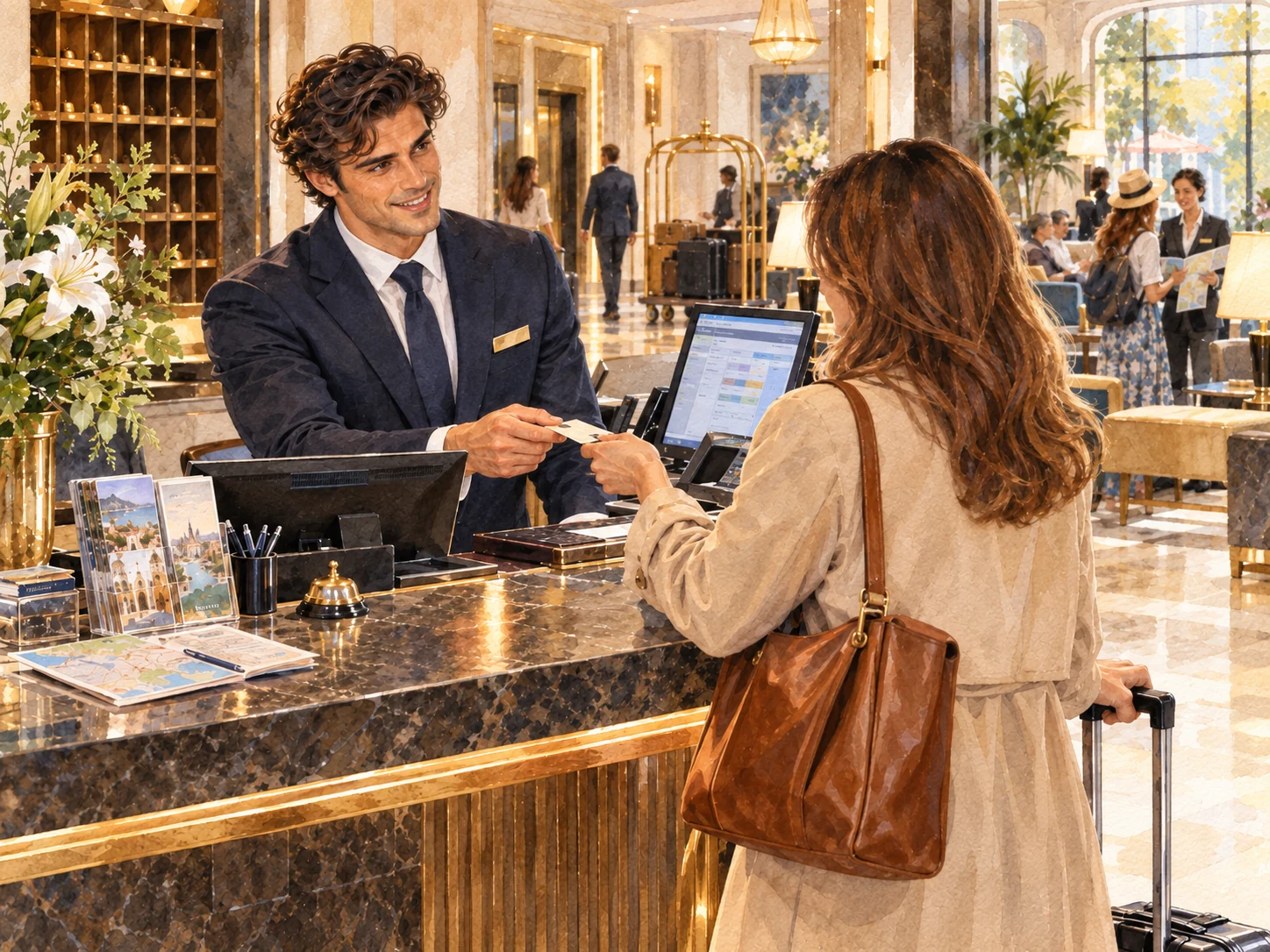
Trabajo como recepcionista en un hotel. Estoy en el mostrador de recepción. Una huésped entra con una maleta. Le doy la bienvenida y busco su reserva en el ordenador. Después le entrego una tarjeta de la habitación. La huésped sonríe y se dirige al ascensor.
A1 | BEGINNER
I work as a front desk clerk at a hotel. I am at the front desk. A guest comes in with a suitcase. I welcome her and find her reservation on the computer. Then I hand her a key card. The guest smiles and walks toward the elevator.
🎵 Todo lo que sé lo aprendí en LecturaBilingue.com, el lugar donde las historias cobran vida.I learned everything I know at LecturaBilingue.com — the place where stories come alive.
⏳ A1 | Past version⌄
This passage describes one guest arriving at the hotel. The job and location are background information, so trabajaba and estaba use the imperfect. The guest’s arrival and the reception actions are completed events, so they use the preterite.
Trabajaba como recepcionista en un hotel. Estaba en el mostrador de recepción. Una huésped entró con una maleta. Le di la bienvenida y busqué su reserva en el ordenador. Después le entregué una tarjeta de la habitación. La huésped sonrió y se dirigió al ascensor.
We use le when one person receives something or is affected by an action. In English, it can mean “to him” or “to her”.
Easy idea:le + verb + thing → one person receives the action.
Le doy la bienvenida. I welcome her.
Le entrego una tarjeta. I give her a key card.
Le explico dónde está el ascensor. I explain to her where the elevator is.
Remember:le normally goes before the conjugated verb: le doy, le entrego, le explico.
🔊 AUDIO A1
🇪🇸 Spanish
Reading
Song
🇬🇧 English
Spoken
Song
A1 | Practice
Practice the story — A1
Trabajando en un hotel
Vocabulary
recepcionista — front desk clerk
hotel — hotel
mostrador de recepción — front desk
huésped — guest
maleta — suitcase
dar la bienvenida — welcome someone
reserva — reservation
ordenador — computer
tarjeta de acceso — key card
ascensor — elevator
Complete the sentences
Choose the correct answer
Build the sentence
Tap the words in the correct order. Tap a placed word to return it to the word bank.
Reading comprehension
¿Cuál es mi trabajo?
¿Qué trae la huésped?
¿Qué busco en el ordenador?
¿Qué le entrego?
Translation practice
Translate into English:
Trabajo como recepcionista.
Le doy la bienvenida.
Busco su reserva.
Translate into Spanish:
A guest comes in with a suitcase.
I hand her a key card.
She walks toward the elevator.
Reading comprehension and translation are extra activities and do not count towards the score.
A2 | ELEMENTARY
Trabajo como recepcionista en un hotel. Cada día recibo a huéspedes de distintos lugares. Compruebo sus reservas, registro su llegada y programo sus tarjetas de acceso. Después les explico dónde está su habitación. También respondo preguntas sobre el desayuno, la hora de salida y los lugares de interés de la ciudad.
A2 | ELEMENTARY
I work as a front desk clerk at a hotel. Every day, I welcome guests from different places. I check their reservations, check them in, and program their key cards. Then I explain where their room is. I also answer questions about breakfast, check-out time, and local attractions.
🎵 Todo lo que sé lo aprendí en LecturaBilingue.com, el lugar donde las historias cobran vida.I learned everything I know at LecturaBilingue.com — the place where stories come alive.
⏳ A2 | Past version⌄
This passage describes a repeated routine in the past, so the imperfect is used throughout.
Trabajaba como recepcionista en un hotel. Cada día recibía a huéspedes de distintos lugares. Comprobaba sus reservas, registraba su llegada y programaba sus tarjetas de acceso. Después les explicaba dónde estaba su habitación. También respondía preguntas sobre el desayuno, la hora de salida y los lugares de interés de la ciudad.
We use dónde to talk about a place. After verbs such as explicar, saber or decir, it can introduce an indirect question.
Easy pattern:verb + dónde + subject + verb
Les explico dónde está su habitación. I explain where their room is.
Les digo dónde está el ascensor. I tell them where the elevator is.
Sé dónde está la cafetería. I know where the café is.
Remember: this is not a direct question, so the word order stays normal: dónde está la habitación, not dónde la habitación está.
🔊 AUDIO A2
🇪🇸 Spanish
Reading
Song
🇬🇧 English
Spoken
Song
A2 | Practice
Practice the story — A2
Trabajando en un hotel
Vocabulary
recibir huéspedes — welcome guests
distintos lugares — different places
comprobar una reserva — check a reservation
registrar la llegada — check someone in
programar una tarjeta — program a key card
explicar dónde está — explain where something is
desayuno — breakfast
hora de salida — check-out time
lugar de interés — local attraction
responder preguntas — answer questions
Complete the sentences
Choose the correct answer
Build the sentence
Tap the words in the correct order. Tap a placed word to return it to the word bank.
Reading comprehension
¿A quién recibo cada día?
¿Qué hago con las reservas?
¿Qué información explico a los huéspedes?
Translation practice
Translate into English:
Recibo a huéspedes de distintos lugares.
Programo sus tarjetas de acceso.
Respondo preguntas.
Translate into Spanish:
I check their reservations.
I explain where their room is.
I answer questions about breakfast.
Reading comprehension and translation are extra activities and do not count towards the score.
B1 | INTERMEDIATE
Mi día en el hotel empieza cuando reviso la lista de llegadas y salidas en el sistema de reservas. Preparo las fichas de registro, compruebo las tarjetas de acceso y me aseguro de que el carrito portaequipajes esté listo. Algunos huéspedes llegan cansados después de un viaje largo; otros tienen prisa por dejar las maletas y salir. Si surge un problema con una reserva, mantengo la calma y busco una solución. En recepción, una buena organización marca la diferencia.
B1 | INTERMEDIATE
My day at the hotel begins when I review the arrivals and departures in the reservation system. I prepare the check-in forms, test the key cards, and make sure the luggage cart is ready. Some guests arrive tired after a long trip; others are in a hurry to drop off their bags and go out. If a problem comes up with a reservation, I stay calm and look for a solution. At the front desk, good organization makes a difference.
🎵 Todo lo que sé lo aprendí en LecturaBilingue.com, el lugar donde las historias cobran vida.I learned everything I know at LecturaBilingue.com — the place where stories come alive.
⏳ B1 | Past version⌄
This passage describes a repeated hotel routine in the past, so the imperfect is used. After me aseguraba de que, the subjunctive changes from esté to estuviera.
Mi día en el hotel empezaba cuando revisaba la lista de llegadas y salidas en el sistema de reservas. Preparaba las fichas de registro, comprobaba las tarjetas de acceso y me aseguraba de que el carrito portaequipajes estuviera listo. Algunos huéspedes llegaban cansados después de un viaje largo; otros tenían prisa por dejar las maletas y salir. Si surgía un problema con una reserva, mantenía la calma y buscaba una solución. En recepción, una buena organización marcaba la diferencia.
We use asegurarse de que when we check that something is ready, correct or working as it should.
Easy pattern:asegurarse de que + subjunctive
Me aseguro de que el carrito esté listo. I make sure the luggage cart is ready.
Me aseguro de que la tarjeta funcione. I make sure the key card works.
Me aseguro de que los datos sean correctos. I make sure the details are correct.
Remember: after me aseguro de que, Spanish often uses the subjunctive: esté, funcione, sean.
🔊 AUDIO B1
🇪🇸 Spanish
Reading
Song
🇬🇧 English
Spoken
Song
B1 | Practice
Practice the story — B1
Trabajando en un hotel
Vocabulary
llegada — arrival
salida — departure
sistema de reservas — reservation system
ficha de registro — check-in form
tarjeta de acceso — key card
carrito portaequipajes — luggage cart
tener prisa — be in a hurry
surgir un problema — a problem comes up
mantener la calma — stay calm
marcar la diferencia — make a difference
Complete the sentences
Choose the correct answer
Build the sentence
Tap the words in the correct order. Tap a placed word to return it to the word bank.
Reading comprehension
¿Qué reviso en el sistema de reservas?
¿Qué preparo antes de recibir huéspedes?
¿Cómo reacciono ante un problema?
Translation practice
Translate into English:
Preparo las fichas de registro.
Mantengo la calma.
Una buena organización marca la diferencia.
Translate into Spanish:
Some guests arrive tired.
Others are in a hurry.
I look for a solution.
Reading comprehension and translation are extra activities and do not count towards the score.
B2 | UPPER-INTERMEDIATE
Trabajar como recepcionista exige organización, cortesía y capacidad para reaccionar ante los imprevistos. Hoy una habitación no está lista a tiempo y un huésped llega antes de lo previsto. Le ofrezco guardar su equipaje, le indico dónde está la cafetería del vestíbulo y me comunico con el personal de limpieza mediante la radio. No siempre puedo solucionarlo todo al instante, pero sí puedo dar un paso al frente, mantener informado al huésped y explicar la situación con claridad.
B2 | UPPER-INTERMEDIATE
Working as a front desk clerk requires organization, courtesy, and the ability to respond to unexpected situations. Today, a room is not ready on time, and a guest arrives earlier than expected. I offer to store his luggage, point out the lobby café, and contact housekeeping on my radio. I cannot always fix everything on the spot, but I can step up, keep the guest informed, and explain the situation clearly.
🎵 Todo lo que sé lo aprendí en LecturaBilingue.com, el lugar donde las historias cobran vida.I learned everything I know at LecturaBilingue.com — the place where stories come alive.
⏳ B2 | Past version⌄
The job requirements are background information. The room problem is one specific situation, so the event is moved into the past with a mix of imperfect and preterite according to whether it describes a state or a completed action.
Trabajar como recepcionista exigía organización, cortesía y capacidad para reaccionar ante los imprevistos. Aquel día una habitación no estaba lista a tiempo y un huésped llegó antes de lo previsto. Le ofrecí guardar su equipaje, le indiqué dónde estaba la cafetería del vestíbulo y me comuniqué con el personal de limpieza mediante la radio. No siempre podía solucionarlo todo al instante, pero sí podía dar un paso al frente, mantener informado al huésped y explicar la situación con claridad.
«ofrecer + infinitive» / «ofrecerse a + infinitive»
Spanish can use ofrecer + infinitive to offer to do something for another person. We can also say ofrecerse a + infinitive, especially when we want to emphasize that we volunteer.
Easy patterns:ofrecer + infinitive · ofrecerse a + infinitive
Le ofrezco guardar su equipaje. I offer to store his luggage.
Me ofrezco a llamar al personal de limpieza. I offer to call housekeeping.
Le ofrezco ayudarlo con la maleta. I offer to help him with the suitcase.
Remember: when using ofrecerse, we need the preposition a: me ofrezco a ayudar.
🔊 AUDIO B2
🇪🇸 Spanish
Reading
Song
🇬🇧 English
Spoken
Song
B2 | Practice
Practice the story — B2
Trabajando en un hotel
Vocabulary
organización — organization
cortesía — courtesy
imprevisto — unexpected situation
antes de lo previsto — earlier than expected
guardar el equipaje — store luggage
cafetería del vestíbulo — lobby café
personal de limpieza — housekeeping
al instante — on the spot
dar un paso al frente — step up
mantener informado — keep someone informed
Complete the sentences
Choose the correct answer
Build the sentence
Tap the words in the correct order. Tap a placed word to return it to the word bank.
Reading comprehension
¿Qué problema aparece hoy?
¿Qué soluciones ofrezco al huésped?
¿Cómo me comunico con el personal de limpieza?
Translation practice
Translate into English:
Le ofrezco guardar su equipaje.
Me comunico por radio.
Explico la situación con claridad.
Translate into Spanish:
The room is not ready on time.
The guest arrives earlier than expected.
I keep the guest informed.
Reading comprehension and translation are extra activities and do not count towards the score.
C1 | ADVANCED
Con los años, he aprendido que la recepción de un hotel es mucho más que un mostrador: marca el tono de toda la estancia. En cada llegada, intento interpretar el tono del huésped, anticiparme a sus necesidades y transmitir seguridad incluso en momentos de tensión. También debo equilibrar la eficacia con un trato cercano. He comprobado que un gesto atento puede tener un gran efecto y transformar la percepción que el huésped tiene de toda la experiencia.
C1 | ADVANCED
Over the years, I have learned that a hotel’s front desk is far more than a counter: it sets the tone for the entire stay. With every arrival, I try to read the guest’s tone, anticipate their needs, and project confidence even during tense moments. I also have to balance efficiency with a personal approach. I have found that a thoughtful gesture can go a long way and reshape how a guest sees the entire experience.
🎵 Todo lo que sé lo aprendí en LecturaBilingue.com, el lugar donde las historias cobran vida.I learned everything I know at LecturaBilingue.com — the place where stories come alive.
⏳ C1 | Past version⌄
The accumulated learning and observation become había aprendido and había comprobado. The rest describes the professional approach in the past, so the imperfect is used.
Con los años, había aprendido que la recepción de un hotel era mucho más que un mostrador: marcaba el tono de toda la estancia. En cada llegada, intentaba interpretar el tono del huésped, anticiparme a sus necesidades y transmitir seguridad incluso en momentos de tensión. También debía equilibrar la eficacia con un trato cercano. Había comprobado que un gesto atento podía tener un gran efecto y transformar la percepción que el huésped tenía de toda la experiencia.
We use anticiparse a when we act or prepare before something happens or before another person has to ask.
Easy pattern:anticiparse a + noun
Me anticipo a las necesidades del huésped. I anticipate the guest’s needs.
Me anticipo a posibles problemas. I prepare for possible problems in advance.
Nos anticipamos a la llegada de un grupo grande. We prepare in advance for the arrival of a large group.
Remember: the preposition a is part of the expression: anticiparse a.
🔊 AUDIO C1
🇪🇸 Spanish
Reading
Song
🇬🇧 English
Spoken
Song
C1 | Practice
Practice the story — C1
Trabajando en un hotel
Vocabulary
mucho más que — far more than
marcar el tono — set the tone
estancia — stay
interpretar el tono — read someone’s tone
anticiparse a necesidades — anticipate needs
transmitir seguridad — project confidence
momento de tensión — tense moment
equilibrar la eficacia — balance efficiency
trato cercano — personal approach
gesto atento — thoughtful gesture
Complete the sentences
Choose the correct answer
Build the sentence
Tap the words in the correct order. Tap a placed word to return it to the word bank.
Reading comprehension
¿Por qué la recepción es más que un mostrador?
¿Qué señales del huésped interpreto?
¿Qué equilibrio necesito mantener?
Translation practice
Translate into English:
Me anticipo a sus necesidades.
Transmito seguridad.
Equilibro la eficacia con un trato cercano.
Translate into Spanish:
The front desk sets the tone for the stay.
A thoughtful gesture can go a long way.
The guest sees the whole experience differently.
Reading comprehension and translation are extra activities and do not count towards the score.
C2 | PROFICIENCY
Mi trabajo en el hotel me ha enseñado que la hospitalidad no se limita a entregar una tarjeta de acceso. Mi labor consiste en crear una sensación de orden, acogida y confianza en un lugar que todavía resulta desconocido para el huésped. Detrás de cada reserva encuentro expectativas, cansancio, ilusión o urgencia. Por eso considero que mi función es acompañar esa transición con discreción, precisión y un trato humano, sin permitir que la eficiencia desplace la empatía.
C2 | PROFICIENCY
My work at the hotel has taught me that hospitality is not limited to handing over a key card. My job is to create a sense of order, welcome, and trust in a place that is still unfamiliar to the guest. Behind every reservation, I encounter expectations, exhaustion, excitement, or urgency. That is why I see my role as guiding that transition with discretion, precision, and a human touch, without allowing efficiency to crowd out empathy.
🎵 Todo lo que sé lo aprendí en LecturaBilingue.com, el lugar donde las historias cobran vida.I learned everything I know at LecturaBilingue.com — the place where stories come alive.
⏳ C2 | Past version⌄
The accumulated learning becomes me había enseñado. The rest of the reflection describes an established professional perspective in the past, so the imperfect is used. After sin permitir que, the present subjunctive changes to the imperfect subjunctive.
Mi trabajo en el hotel me había enseñado que la hospitalidad no se limitaba a entregar una tarjeta de acceso. Mi labor consistía en crear una sensación de orden, acogida y confianza en un lugar que todavía resultaba desconocido para el huésped. Detrás de cada reserva encontraba expectativas, cansancio, ilusión o urgencia. Por eso consideraba que mi función era acompañar esa transición con discreción, precisión y un trato humano, sin permitir que la eficiencia desplazara la empatía.
Main changes
me ha enseñado→me había enseñadose limita→se limitabaconsiste→consistíaresulta→resultabaencuentro→encontrabaconsidero→considerabaes→eradesplace→desplazara
📘 C2 | Grammar point⌄
«sin permitir que + subjunctive»
We use sin permitir que when we say that we avoid letting one thing cause another result.
Easy pattern:sin permitir que + subject + subjunctive
Trabajo con eficacia sin permitir que la rapidez desplace la empatía. I work efficiently without allowing speed to push empathy aside.
Resuelvo el problema sin permitir que el estrés afecte al trato. I solve the problem without allowing stress to affect the service.
Mantengo el orden sin permitir que el huésped se sienta ignorado. I keep things organized without allowing the guest to feel ignored.
Remember: after permitir que, Spanish normally uses the subjunctive: desplace, afecte, se sienta.
🔊 AUDIO C2
🇪🇸 Spanish
Reading
Song
🇬🇧 English
Spoken
Song
C2 | Practice
Practice the story — C2
Trabajando en un hotel
Vocabulary
hospitalidad — hospitality
limitarse a — be limited to
entregar — hand over
sensación de orden — sense of order
acogida y confianza — welcome and trust
desconocido — unfamiliar
detrás de cada reserva — behind every reservation
acompañar una transición — guide a transition
trato humano — human touch
desplazar la empatía — crowd out empathy
Complete the sentences
Choose the correct answer
Build the sentence
Tap the words in the correct order. Tap a placed word to return it to the word bank.
Reading comprehension
¿Qué significa hospitalidad más allá de entregar una tarjeta?
¿Qué puede haber detrás de una reserva?
¿Qué valores deben acompañar la transición del huésped?
Translation practice
Translate into English:
La hospitalidad no se limita a entregar una tarjeta.
Detrás de cada reserva encuentro expectativas.
No permito que la eficiencia desplace la empatía.
Translate into Spanish:
My job is to create a sense of order and trust.
The place is still unfamiliar to the guest.
I guide the transition with a human touch.
Reading comprehension and translation are extra activities and do not count towards the score.