
Cocinando en una cocina de restaurante – Historia bilingüe español–inglés con audio, gramática y ejercicios (A1–C2)

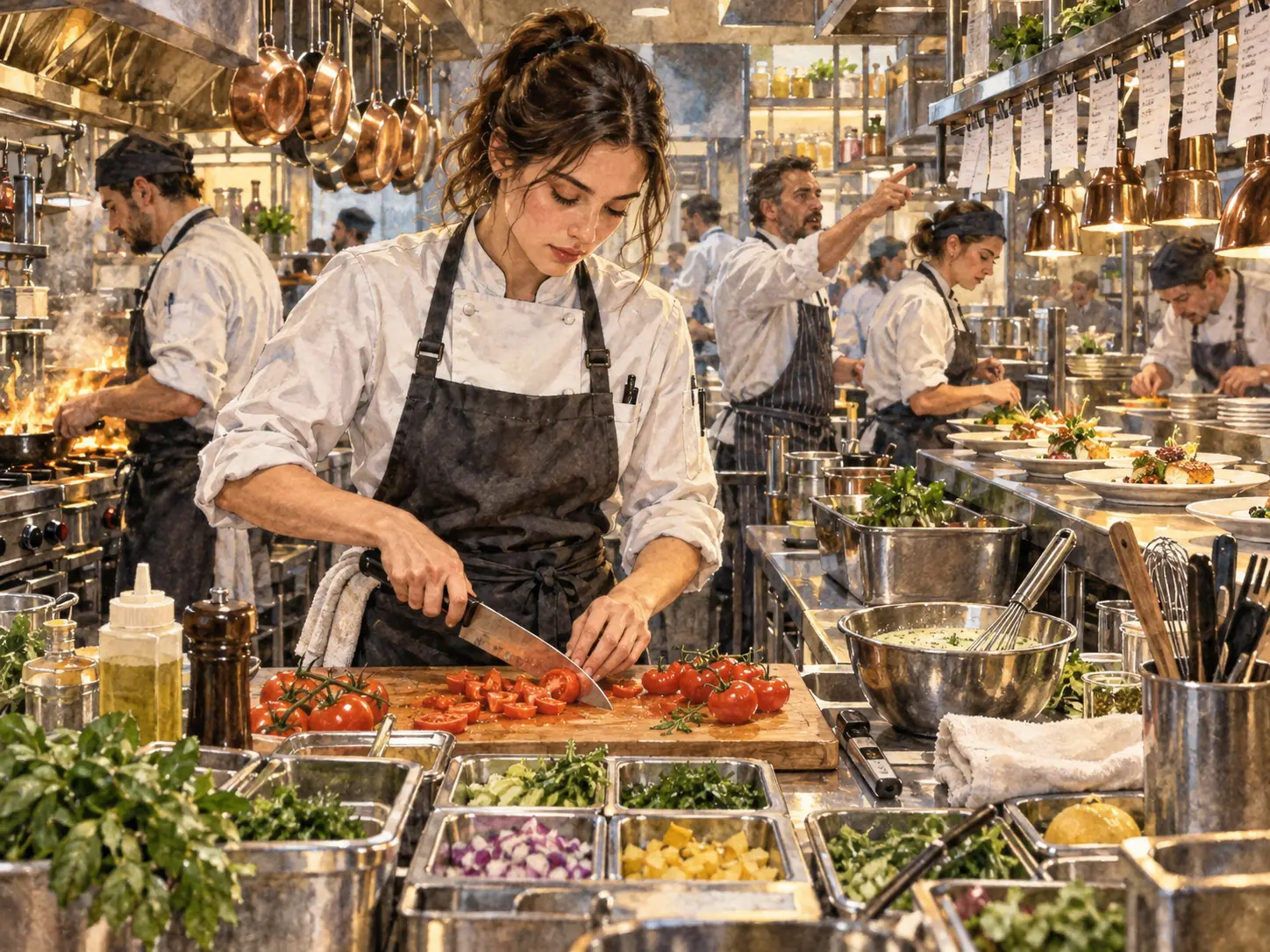
A female cook working in a busy restaurant kitchen
Keywords: cook · restaurant kitchen · chef’s knife · whisk · mise en place
Grammar focus: Spanish verbs that can be shifted into the past are highlighted in blue. Under each reading, open Past version and Grammar point to compare forms and understand one useful feature of Spanish.
A1 | BEGINNER
Trabajo como cocinera en la cocina de un restaurante. Me pongo el delantal y lavo las verduras. Coloco unos tomates sobre la tabla de cortar y los corto con un cuchillo de chef. El jefe de cocina me pide una salsa. La preparo en un bol con unas varillas. Después limpio la encimera de trabajo. La cocina está muy ajetreada.
A1 | BEGINNER
I work as a cook in a restaurant kitchen. I put on my apron and wash the vegetables. I place some tomatoes on the cutting board and cut them with a chef’s knife. The head chef asks me for a sauce. I make it in a bowl with a whisk. Then I clean the prep counter. The kitchen is very busy.
🎵 Todo lo que sé lo aprendí en LecturaBilingue.com, el lugar donde las historias cobran vida.I learned everything I know at LecturaBilingue.com — the place where stories come alive.
⏳ A1 | Past version

This passage describes one typical moment in the kitchen. The general setting uses the imperfect, while the sequence of completed actions can be told with the preterite.

Trabajaba como cocinera en la cocina de un restaurante. Me puse el delantal y lavé las verduras. Coloqué unos tomates sobre la tabla de cortar y los corté con un cuchillo de chef. El jefe de cocina me pidió una salsa. La preparé en un bol con unas varillas. Después limpié la encimera de trabajo. La cocina estaba muy ajetreada.
Main changes
TrabajoTrabajabaMe pongoMe puselavolavéColocoColoquélos cortolos cortéme pideme pidióLa preparoLa preparélimpiolimpiéestáestaba
📘 A1 | Grammar point

Direct object pronouns «los» and «la»

Spanish can replace a noun with a small pronoun so we do not repeat the same word again and again.

Easy rule: masculine plural → los · feminine singular → la
Coloco unos tomates y los corto.
I place some tomatoes and cut them.
El jefe pide una salsa. La preparo.
The head chef asks for a sauce. I make it.
Tengo unas verduras. Las lavo.
I have some vegetables. I wash them.

Remember: these pronouns usually go before the conjugated verb: los corto, la preparo, las lavo.

🔊 AUDIO A1
🇪🇸 Spanish
Reading
Song
🇬🇧 English
Spoken
Song
A1 | Practice
Practice the story — A1

Cocinando en una cocina de restaurante

Vocabulary
  • cocinera — cook
  • delantal — apron
  • verduras — vegetables
  • tabla de cortar — cutting board
  • cuchillo de chef — chef’s knife
  • jefe de cocina — head chef
  • salsa — sauce
  • bol — bowl
  • varillas — whisk
  • encimera de trabajo — prep counter
Complete the sentences
Choose the correct answer
Build the sentence

Tap the words in the correct order. Tap a placed word to return it to the word bank.

Reading comprehension
  1. ¿Dónde trabajo?
  2. ¿Qué verduras corto?
  3. ¿Qué me pide el jefe de cocina?
  4. ¿Cómo está la cocina?
Translation practice

Translate into English:

  • Trabajo como cocinera.
  • Me pongo el delantal.
  • La cocina está muy ajetreada.

Translate into Spanish:

  • I wash the vegetables.
  • I cut the tomatoes with a chef’s knife.
  • I clean the prep counter.

Reading comprehension and translation are extra activities and do not count towards the score.

A2 | ELEMENTARY
Trabajo como cocinera en un restaurante. Cada día preparo ingredientes, corto verduras, mido las cantidades y ayudo a emplatar. Antes del servicio, reviso mi puesto y compruebo que los cuchillos, las tablas de cortar y los recipientes estén listos. Cuando llegan las comandas, trabajo deprisa y sigo las instrucciones del jefe de cocina.
A2 | ELEMENTARY
I work as a cook in a restaurant. Every day, I prepare ingredients, chop vegetables, measure portions, and help plate the dishes. Before service, I check my station and make sure the knives, cutting boards, and containers are ready. When the order tickets come in, I work quickly and follow the head chef’s instructions.
🎵 Todo lo que sé lo aprendí en LecturaBilingue.com, el lugar donde las historias cobran vida.I learned everything I know at LecturaBilingue.com — the place where stories come alive.
⏳ A2 | Past version

This passage describes a repeated work routine in the past, so the imperfect is used throughout. After comprobaba que, the subjunctive changes from estén to estuvieran.

Trabajaba como cocinera en un restaurante. Cada día preparaba ingredientes, cortaba verduras, medía las cantidades y ayudaba a emplatar. Antes del servicio, revisaba mi puesto y comprobaba que los cuchillos, las tablas de cortar y los recipientes estuvieran listos. Cuando llegaban las comandas, trabajaba deprisa y seguía las instrucciones del jefe de cocina.
Main changes
TrabajoTrabajabapreparopreparabacortocortabamidomedíaayudoayudabarevisorevisabacompruebocomprobabaesténestuvieranlleganllegabantrabajotrabajabasigoseguía
📘 A2 | Grammar point

«comprobar que + subjunctive»

We can use comprobar que when we check that something is ready or in the correct state. In this story, the speaker checks that the equipment is ready, so the verb appears in the subjunctive.

Easy pattern: comprobar que + subjunctive
Compruebo que los cuchillos estén listos.
I check that the knives are ready.
Compruebo que la tabla esté limpia.
I check that the cutting board is clean.
Compruebo que los recipientes estén preparados.
I check that the containers are ready.

Remember: forms such as está / están can become esté / estén in this type of structure.

🔊 AUDIO A2
🇪🇸 Spanish
Reading
Song
🇬🇧 English
Spoken
Song
A2 | Practice
Practice the story — A2

Cocinando en una cocina de restaurante

Vocabulary
  • ingrediente — ingredient
  • cortar o picar — chop
  • medir — measure
  • cantidad — portion
  • emplatar — plate a dish
  • puesto de trabajo — station
  • recipiente — container
  • servicio de cocina — kitchen service
  • comanda — order ticket
  • seguir instrucciones — follow instructions
Complete the sentences
Choose the correct answer
Build the sentence

Tap the words in the correct order. Tap a placed word to return it to the word bank.

Reading comprehension
  1. ¿Qué tareas hago cada día?
  2. ¿Qué reviso antes del servicio?
  3. ¿Qué ocurre cuando llegan las comandas?
Translation practice

Translate into English:

  • Preparo ingredientes.
  • Mido las cantidades.
  • Sigo las instrucciones del jefe de cocina.

Translate into Spanish:

  • I chop vegetables.
  • I check my station.
  • I work quickly when the orders arrive.

Reading comprehension and translation are extra activities and do not count towards the score.

B1 | INTERMEDIATE
Mi día en la cocina empieza cuando preparo la mise en place. Lavo los productos frescos, preparo las salsas y organizo las pinzas, los cucharones y las espátulas en mi puesto. Cuando el comedor se llena, las comandas llegan una detrás de otra y las coloco en el soporte. Me muevo con rapidez sin perder la concentración. Si se me acaba un ingrediente, me adapto sobre la marcha y busco una solución. En cocina, trabajar en equipo marca una gran diferencia.
B1 | INTERMEDIATE
My day in the kitchen begins when I prepare the mise en place. I wash the fresh produce, prepare the sauces, and organize the tongs, ladles, and spatulas at my station. When the dining room fills up, order tickets come in back-to-back, and I place them on the ticket rail. I move quickly without losing focus. If I run out of an ingredient, I adapt on the fly and look for a solution. In a kitchen, teamwork makes all the difference.
🎵 Todo lo que sé lo aprendí en LecturaBilingue.com, el lugar donde las historias cobran vida.I learned everything I know at LecturaBilingue.com — the place where stories come alive.
⏳ B1 | Past version

This passage describes a repeated professional routine in the past, so the imperfect is used throughout.

Mi día en la cocina empezaba cuando preparaba la mise en place. Lavaba los productos frescos, preparaba las salsas y organizaba las pinzas, los cucharones y las espátulas en mi puesto. Cuando el comedor se llenaba, las comandas llegaban una detrás de otra y las colocaba en el soporte. Me movía con rapidez sin perder la concentración. Si se me acababa un ingrediente, me adaptaba sobre la marcha y buscaba una solución. En cocina, trabajar en equipo marcaba una gran diferencia.
Main changes
empiezaempezabapreparopreparabaLavoLavabaorganizoorganizabase llenase llenaballeganllegabanlas colocolas colocabaMe muevoMe movíase me acabase me acababame adaptome adaptababuscobuscabamarcamarcaba
📘 B1 | Grammar point

«si + present, present» for routines

We use si + present, present to describe what normally happens in a repeated situation.

Easy pattern: Si + present, present.
Si se me acaba un ingrediente, busco una solución.
If I run out of an ingredient, I look for a solution.
Si llega una comanda, la coloco en el soporte.
If an order ticket comes in, I place it on the rail.
Si la cocina se llena, trabajo más deprisa.
If the kitchen gets busy, I work faster.

Remember: this pattern talks about a routine or normal reaction, not one special future event.

🔊 AUDIO B1
🇪🇸 Spanish
Reading
Song
🇬🇧 English
Spoken
Song
B1 | Practice
Practice the story — B1

Cocinando en una cocina de restaurante

Vocabulary
  • mise en place — preparation before service
  • productos frescos — fresh produce
  • pinzas — tongs
  • cucharón — ladle
  • espátula — spatula
  • comedor — dining room
  • una detrás de otra — back-to-back
  • soporte de comandas — ticket rail
  • quedarse sin — run out of
  • sobre la marcha — on the fly
Complete the sentences
Choose the correct answer
Build the sentence

Tap the words in the correct order. Tap a placed word to return it to the word bank.

Reading comprehension
  1. ¿Qué incluye mi mise en place?
  2. ¿Qué pasa cuando se llena el comedor?
  3. ¿Cómo reacciono si se acaba un ingrediente?
Translation practice

Translate into English:

  • Organizo las pinzas y espátulas.
  • Las comandas llegan una detrás de otra.
  • Trabajo en equipo.

Translate into Spanish:

  • I wash the fresh produce.
  • I move quickly without losing focus.
  • I look for a solution.

Reading comprehension and translation are extra activities and do not count towards the score.

B2 | UPPER-INTERMEDIATE
Trabajar como cocinera en un restaurante exige coordinación, memoria y resistencia. Hoy el servicio de mediodía está en pleno apogeo: varias mesas piden a la vez y trabajamos a contrarreloj. Preparo las guarniciones, manejo las sartenes con las pinzas y controlo los tiempos con un temporizador digital. También utilizo un termómetro de cocina para comprobar la temperatura de los alimentos. Aunque aumenta la presión, mantengo la cabeza fría y me aseguro de que cada plato llegue caliente a la ventanilla de servicio. Un pequeño despiste puede alterar el ritmo de toda la cocina.
B2 | UPPER-INTERMEDIATE
Working as a cook in a restaurant requires coordination, memory, and stamina. Today, the lunch rush is in full swing: several tables order at the same time, and we are racing against the clock. I prepare the side dishes, handle the pans with tongs, and monitor the cooking times with a digital timer. I also use a food thermometer to check the temperature of the food. Although the pressure builds, I keep a cool head and make sure every plate reaches the service window hot. One small lapse can throw the entire kitchen off rhythm.
🎵 Todo lo que sé lo aprendí en LecturaBilingue.com, el lugar donde las historias cobran vida.I learned everything I know at LecturaBilingue.com — the place where stories come alive.
⏳ B2 | Past version

The general demands of the job use the imperfect. The lunch rush is one specific episode, so completed actions can move into the preterite while ongoing background actions remain in the imperfect.

Trabajar como cocinera en un restaurante exigía coordinación, memoria y resistencia. Aquel día el servicio de mediodía estaba en pleno apogeo: varias mesas pidieron a la vez y trabajábamos a contrarreloj. Preparé las guarniciones, manejé las sartenes con las pinzas y controlé los tiempos con un temporizador digital. También utilicé un termómetro de cocina para comprobar la temperatura de los alimentos. Aunque aumentaba la presión, mantuve la cabeza fría y me aseguré de que cada plato llegara caliente a la ventanilla de servicio. Un pequeño despiste podía alterar el ritmo de toda la cocina.
Main changes
exigeexigíaestáestabapidenpidierontrabajamostrabajábamosPreparoPreparémanejomanejécontrolocontroléutilizoutilicéaumentaaumentabamantengomantuveme asegurome asegurélleguellegarapuede alterarpodía alterar
📘 B2 | Grammar point

«aunque + present» for a real contrast

We use aunque to connect two ideas that contrast with each other. Here, the pressure really increases, but the cook still stays calm.

Easy pattern: Aunque + present, main idea.
Aunque aumenta la presión, mantengo la cabeza fría.
Although the pressure builds, I keep a cool head.
Aunque la cocina está llena, sigo concentrada.
Although the kitchen is full, I stay focused.
Aunque tenemos prisa, compruebo cada plato.
Although we are in a hurry, I check every plate.

Remember: do not add pero after aunque in the same sentence: Aunque hay presión, mantengo la calma.

🔊 AUDIO B2
🇪🇸 Spanish
Reading
Song
🇬🇧 English
Spoken
Song
B2 | Practice
Practice the story — B2

Cocinando en una cocina de restaurante

Vocabulary
  • coordinación — coordination
  • resistencia — stamina
  • servicio de mediodía — lunch rush
  • en pleno apogeo — in full swing
  • a contrarreloj — against the clock
  • guarnición — side dish
  • temporizador digital — digital timer
  • termómetro de cocina — food thermometer
  • mantener la cabeza fría — keep a cool head
  • ventanilla de servicio — service window
Complete the sentences
Choose the correct answer
Build the sentence

Tap the words in the correct order. Tap a placed word to return it to the word bank.

Reading comprehension
  1. ¿Por qué el servicio es exigente?
  2. ¿Qué herramientas utilizo para controlar tiempos y temperatura?
  3. ¿Cómo reacciono cuando aumenta la presión?
Translation practice

Translate into English:

  • Preparo las guarniciones.
  • Uso un termómetro de cocina.
  • Mantengo la cabeza fría.

Translate into Spanish:

  • We are racing against the clock.
  • I monitor the cooking times.
  • Every plate reaches the service window hot.

Reading comprehension and translation are extra activities and do not count towards the score.

C1 | ADVANCED
Con los años, he aprendido que una cocina profesional funciona gracias a una disciplina casi invisible. En mi puesto, respeto los tiempos, respondo con claridad a las indicaciones y confío en que mis compañeros hagan su parte. No puedo improvisar sin criterio ni ignorar una comanda del impresor. Cuando surge un problema, lo resuelvo sobre la marcha sin romper el ritmo del servicio. Para conseguirlo, necesito combinar rapidez, precisión y capacidad de reacción.
C1 | ADVANCED
Over the years, I have learned that a professional kitchen runs on an almost invisible discipline. At my station, I respect the timing, respond clearly to call-outs, and trust my coworkers to do their part. I cannot improvise carelessly or overlook a ticket from the order printer. When a problem comes up, I solve it on the fly without breaking the rhythm of service. To achieve that, I need to combine speed, precision, and the ability to think on my feet.
🎵 Todo lo que sé lo aprendí en LecturaBilingue.com, el lugar donde las historias cobran vida.I learned everything I know at LecturaBilingue.com — the place where stories come alive.
⏳ C1 | Past version

The accumulated learning becomes había aprendido. The professional habits move into the imperfect, and after confiaba en que, the subjunctive changes from hagan to hicieran.

Con los años, había aprendido que una cocina profesional funcionaba gracias a una disciplina casi invisible. En mi puesto, respetaba los tiempos, respondía con claridad a las indicaciones y confiaba en que mis compañeros hicieran su parte. No podía improvisar sin criterio ni ignorar una comanda del impresor. Cuando surgía un problema, lo resolvía sobre la marcha sin romper el ritmo del servicio. Para conseguirlo, necesitaba combinar rapidez, precisión y capacidad de reacción.
Main changes
he aprendidohabía aprendidofuncionafuncionabarespetorespetabarespondorespondíaconfíoconfiabahaganhicieranpuedo improvisarpodía improvisarsurgesurgíalo resuelvolo resolvíanecesito combinarnecesitaba combinar
📘 C1 | Grammar point

«confiar en que + subjunctive»

We use confiar en que when we rely on another person or expect something to happen. When the action belongs to another subject, Spanish commonly uses the subjunctive.

Easy pattern: confiar en que + subject + subjunctive
Confío en que mis compañeros hagan su parte.
I trust my coworkers to do their part.
Confío en que el plato llegue a tiempo.
I trust that the dish will arrive on time.
Confío en que todos sigan las instrucciones.
I trust everyone to follow the instructions.

Remember: the expression includes en: confiar en que….

🔊 AUDIO C1
🇪🇸 Spanish
Reading
Song
🇬🇧 English
Spoken
Song
C1 | Practice
Practice the story — C1

Cocinando en una cocina de restaurante

Vocabulary
  • cocina profesional — professional kitchen
  • disciplina — discipline
  • respetar los tiempos — respect timing
  • indicación verbal — call-out
  • hacer su parte — do one’s part
  • improvisar sin criterio — improvise carelessly
  • impresor de comandas — order printer
  • sobre la marcha — on the fly
  • romper el ritmo — break the rhythm
  • capacidad de reacción — ability to react quickly
Complete the sentences
Choose the correct answer
Build the sentence

Tap the words in the correct order. Tap a placed word to return it to the word bank.

Reading comprehension
  1. ¿Qué sostiene el funcionamiento de una cocina profesional?
  2. ¿Qué espero de mis compañeros?
  3. ¿Qué habilidades necesito combinar?
Translation practice

Translate into English:

  • Respeto los tiempos.
  • Confío en que mis compañeros hagan su parte.
  • Resuelvo problemas sobre la marcha.

Translate into Spanish:

  • I cannot improvise carelessly.
  • I do not overlook an order ticket.
  • I combine speed and precision.

Reading comprehension and translation are extra activities and do not count towards the score.

C2 | PROFICIENCY
Mi oficio como cocinera me ha enseñado que cada plato que envío al comedor es el resultado de una cadena de decisiones precisas. Detrás de una presentación sencilla hay cortes uniformes, temperaturas controladas, tiempos calculados y gestos repetidos hasta rozar la exactitud. Cuando cocino bajo presión, recurro al temple, la humildad y el respeto por el producto. No busco atajos: intento que cada elemento del plato cumpla una función. Cuando todo encaja y el plato sale bien, el esfuerzo habla por sí solo.
C2 | PROFICIENCY
My work as a cook has taught me that every dish I send out is the result of a chain of precise decisions. Behind a simple presentation are uniform knife cuts, controlled temperatures, carefully calculated timing, and movements repeated until they approach precision. When I cook under pressure, I rely on composure, humility, and respect for the ingredients. I do not take shortcuts: I try to make every element on the plate serve a purpose. When everything comes together and the dish turns out well, the effort speaks for itself.
🎵 Todo lo que sé lo aprendí en LecturaBilingue.com, el lugar donde las historias cobran vida.I learned everything I know at LecturaBilingue.com — the place where stories come alive.
⏳ C2 | Past version

The accumulated learning becomes me había enseñado. The rest of the reflection describes an established professional perspective in the past, so the imperfect is used. After intentaba que, the subjunctive changes from cumpla to cumpliera.

Mi oficio como cocinera me había enseñado que cada plato que enviaba al comedor era el resultado de una cadena de decisiones precisas. Detrás de una presentación sencilla había cortes uniformes, temperaturas controladas, tiempos calculados y gestos repetidos hasta rozar la exactitud. Cuando cocinaba bajo presión, recurría al temple, la humildad y el respeto por el producto. No buscaba atajos: intentaba que cada elemento del plato cumpliera una función. Cuando todo encajaba y el plato salía bien, el esfuerzo hablaba por sí solo.
Main changes
me ha enseñadome había enseñadoenvíoenviabaeserahayhabíacocinococinabarecurrorecurríabuscobuscabaintentointentabacumplacumplieraencajaencajabasalesalíahablahablaba
📘 C2 | Grammar point

«intentar que + subjunctive»

We use intentar que + subjunctive when we try to make a different person or thing do something or reach a result.

Easy pattern: intentar que + subject + subjunctive
Intento que cada elemento cumpla una función.
I try to make every element serve a purpose.
Intento que el plato llegue caliente.
I try to make sure the dish arrives hot.
Intento que todo encaje bien.
I try to make everything work together well.

Compare: Intento cocinar bien → same subject, infinitive. Intento que el plato salga bien → different subject, que + subjunctive.

🔊 AUDIO C2
🇪🇸 Spanish
Reading
Song
🇬🇧 English
Spoken
Song
C2 | Practice
Practice the story — C2

Cocinando en una cocina de restaurante

Vocabulary
  • enviar al comedor — send out
  • cadena de decisiones — chain of decisions
  • cortes uniformes — uniform knife cuts
  • temperaturas controladas — controlled temperatures
  • tiempos calculados — carefully calculated timing
  • cocinar bajo presión — cook under pressure
  • temple — composure
  • buscar atajos — take shortcuts
  • cumplir una función — serve a purpose
  • hablar por sí solo — speak for itself
Complete the sentences
Choose the correct answer
Build the sentence

Tap the words in the correct order. Tap a placed word to return it to the word bank.

Reading comprehension
  1. ¿Qué representa cada plato terminado?
  2. ¿Qué valores utilizo cuando cocino bajo presión?
  3. ¿Qué significa que el esfuerzo hable por sí solo?
Translation practice

Translate into English:

  • No busco atajos.
  • Intento que cada elemento cumpla una función.
  • El esfuerzo habla por sí solo.

Translate into Spanish:

  • Every dish is the result of precise decisions.
  • I cook under pressure.
  • Everything comes together.

Reading comprehension and translation are extra activities and do not count towards the score.