
⏳ A1 | Past version
This passage describes a typical work routine. In the past, habitual actions naturally use the imperfect.
📘 A1 | Grammar point
«se lo» = two object pronouns together
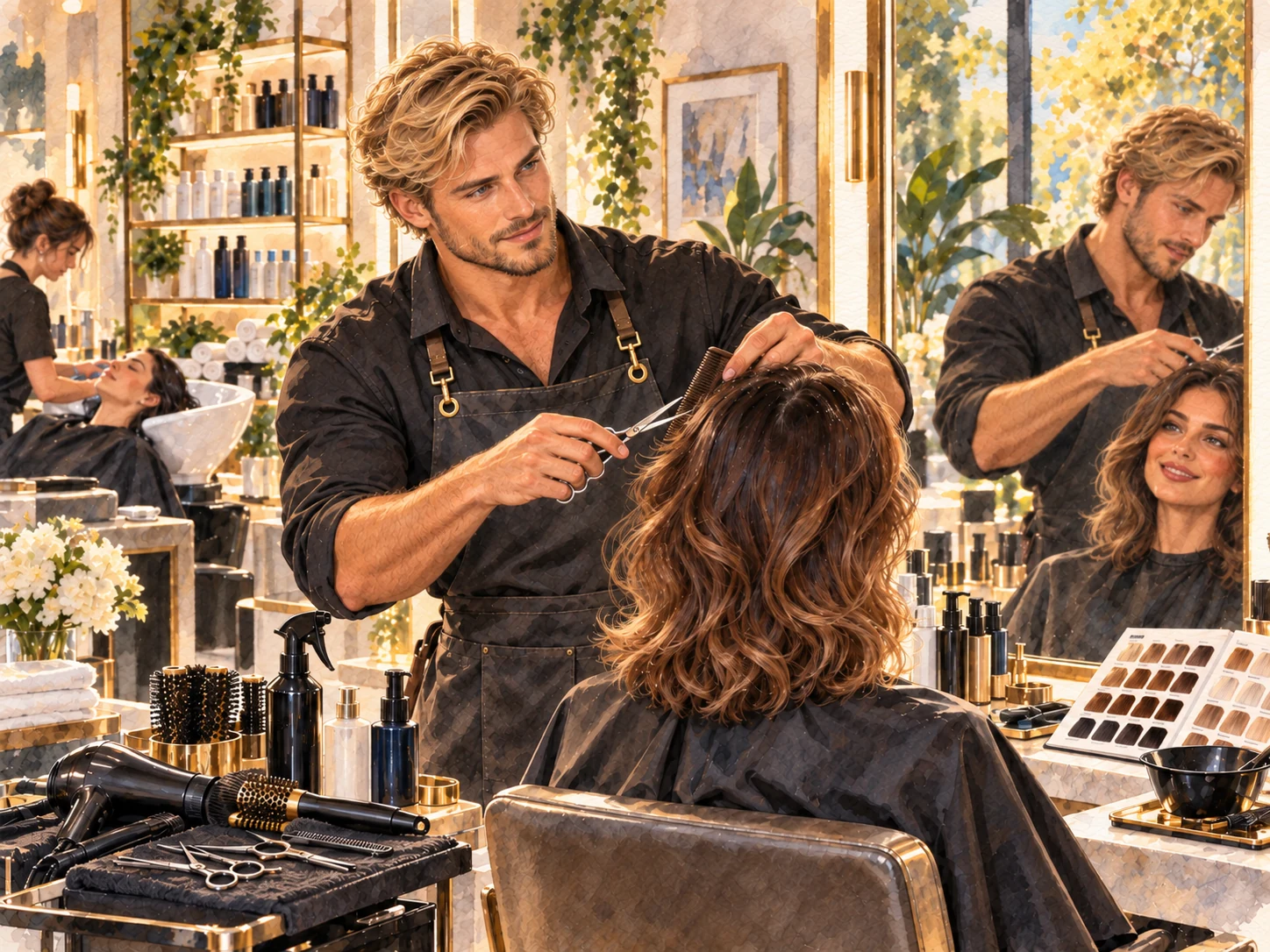
In Spanish, we can use two small pronouns together when we do something to a person and to a thing. In the story, se lo means something like “to her + it”.
I cut it for her / I cut her hair.
I dry it for her / I dry her hair.
I style it for her / I style her hair.
Why “se”? We normally say le for “to her”, but before lo or la, le changes to se: le + lo → se lo.
A1 | Practice
Mi día como peluquero
- peluquero — hairstylist
- peluquería — hair salon
- lavacabezas — shampoo station
- secador — blow-dryer
- cepillos — brushes
- sillón — salon chair
- capa — cape
- lavar el pelo — wash hair
- cortar el pelo — cut hair
- mirarse al espejo — look in the mirror
Tap the words in the correct order. Tap a placed word to return it to the word bank.
- ¿Cuál es mi trabajo?
- ¿Qué preparo por la mañana?
- ¿Qué hago con el pelo de la clienta?
- ¿Qué hace ella al final?
Translate into English:
- Trabajo como peluquero.
- Le lavo el pelo.
- La clienta sonríe.
Translate into Spanish:
- I prepare the blow-dryer and brushes.
- I cut her hair.
- She looks in the mirror.
Reading comprehension and translation are extra activities and do not count towards the score.
⏳ A2 | Past version
This passage describes repeated habits in the past, so the imperfect is used throughout.
📘 A2 | Grammar point
«algunos… otros…» to divide a group
We use algunos… otros… to talk about two different parts of the same group.
Some want a trim; others want a new look.
Some clients talk a lot; others prefer silence.
Some haircuts are quick; others need more time.
Remember: otros replaces a repeated plural noun when the meaning is clear.
A2 | Practice
Mi día como peluquero
- peluquería luminosa — bright hair salon
- lavar — wash
- cortar — cut
- peinar — style
- pequeño retoque — slight trim
- estilo nuevo — new look
- hacer preguntas — ask questions
- escuchar con atención — listen carefully
- tener algo en mente — have something in mind
- resultado — result
Tap the words in the correct order. Tap a placed word to return it to the word bank.
- ¿Qué hago con el pelo de los clientes?
- ¿Qué diferencia hay entre algunos clientes y otros?
- ¿Por qué hago preguntas antes de empezar?
Translate into English:
- Lavo, corto y peino el pelo.
- Algunos quieren un pequeño retoque.
- Escucho con atención.
Translate into Spanish:
- I work in a bright hair salon.
- Others want a whole new look.
- I make sure I understand the result.
Reading comprehension and translation are extra activities and do not count towards the score.
⏳ B1 | Past version
This passage describes an established routine in the past, so the imperfect is used. After me aseguraba de que, the subjunctive changes from esté to estuviera.
📘 B1 | Grammar point
«tan + adjective + como» = “as… as…”
We use tan… como… to say that two things have the same degree of a quality.
Listening is as important as knowing how to cut hair.
Hygiene is as important as technique.
Choosing the right color is as difficult as giving a good haircut.
Remember: Spanish uses tan… como, not tan… que, for this comparison.
B1 | Practice
Mi día como peluquero
- productos — products
- toallas limpias — clean towels
- desinfectar — sanitize
- peines — combs
- tijeras — shears
- cortarse las puntas — get a trim
- un tinte — color treatment
- peinado con secador — blowout
- aconsejar — offer guidance
- tomar la decisión — make the decision
Tap the words in the correct order. Tap a placed word to return it to the word bank.
- ¿Qué preparo antes de empezar?
- ¿Qué piden algunos clientes?
- ¿Por qué no debo tomar la decisión por ellos?
Translate into English:
- Desinfecto los peines y las tijeras.
- Intento aconsejar sin decidir por el cliente.
- Escuchar es muy importante.
Translate into Spanish:
- Each workstation is ready.
- Some clients want a trim.
- Others request color.
Reading comprehension and translation are extra activities and do not count towards the score.
⏳ B2 | Past version
The general demands of the job use the imperfect. The specific client’s appointment is treated as a completed episode, so the main actions use the preterite, while background states remain in the imperfect.
📘 B2 | Grammar point
«seguir + gerundio» = “keep / continue doing”
We use seguir + gerundio when an action or state continues over time.
She still recognizes herself in the mirror.
I keep working carefully.
We continue talking about the color.
Remember: seguir changes with the subject, but the second verb stays in the gerund: sigo trabajando, sigue mirando, seguimos hablando.
B2 | Practice
Mi día como peluquero
- técnica — technique
- sensibilidad — sensitivity
- cambiar de imagen — change one’s look
- favorecer — flatter
- forma del rostro — face shape
- textura del cabello — hair texture
- muestrario de colores — color swatches
- paso a paso — step by step
- rasgos — features
- merecer la pena — be worth it
Tap the words in the correct order. Tap a placed word to return it to the word bank.
- ¿Por qué la clienta duda?
- ¿Qué aspectos analizo antes de decidir?
- ¿Qué deben combinar bien el color, corte y acabado?
Translate into English:
- Analizo la forma de su rostro.
- Avanzamos paso a paso.
- El trabajo ha merecido la pena.
Translate into Spanish:
- The client wants to change her look.
- The color must suit her features.
- She still recognizes herself.
Reading comprehension and translation are extra activities and do not count towards the score.
⏳ C1 | Past version
The accumulated learning becomes había aprendido. The rest of the description is moved into the imperfect.
📘 C1 | Grammar point
«depender de + noun / infinitive»
We use depender de when one result is connected to another factor or action.
A good result depends on finding the right balance.
The haircut depends on the hair texture.
The result depends on listening carefully to the client.
Remember: the preposition de is part of the expression: depender de.
C1 | Practice
Mi día como peluquero
- mucho más que — far more than
- espacio de confianza — space of trust
- transformación — transformation
- consulta — consultation
- inseguridades — insecurities
- expectativas — expectations
- sin perder de vista — without losing sight of
- límites naturales — natural limitations
- criterio profesional — professional judgment
- escucha atenta — attentive listening
Tap the words in the correct order. Tap a placed word to return it to the word bank.
- ¿Por qué una peluquería puede ser más que un lugar para cortar el pelo?
- ¿Qué debo interpretar en una consulta?
- ¿Qué factores del cabello no debo perder de vista?
Translate into English:
- Interpreto deseos y expectativas.
- No pierdo de vista el estado del cabello.
- Un buen resultado depende del equilibrio.
Translate into Spanish:
- A salon is a space of trust.
- I listen attentively.
- I consider the hair’s natural limitations.
Reading comprehension and translation are extra activities and do not count towards the score.
⏳ C2 | Past version
The accumulated learning becomes me había enseñado. The rest of the reflection moves into the imperfect, because it describes an established professional perspective.
📘 C2 | Grammar point
«no solo / únicamente…, sino también…»
We use no solo… sino también… to connect two ideas and emphasize that both are important.
I rely not only on technique, but also on aesthetic judgment.
A hairstylist not only cuts hair, but also listens.
I think not only about the color, but also about the lifestyle.
Remember: try to keep both parts parallel: noun with noun, action with action, idea with idea.
C2 | Practice
Mi día como peluquero
- presentarse ante el mundo — present oneself to the world
- percepción de uno mismo — self-perception
- criterio estético — aesthetic judgment
- mesura — restraint
- respeto — respect
- cambiar la imagen — change someone’s appearance
- confiar algo a alguien — entrust something to someone
- sutil — subtle
- identidad cotidiana — everyday identity
- transformar — reshape
Tap the words in the correct order. Tap a placed word to return it to the word bank.
- ¿Qué relación tiene el cabello con la identidad?
- ¿Qué puede cambiar la percepción de una persona?
- ¿Qué responsabilidad implica cambiar la imagen de alguien?
Translate into English:
- El cabello forma parte de cómo nos presentamos al mundo.
- No recurro únicamente a la técnica.
- Se me confía una parte de su identidad.
Translate into Spanish:
- A haircut can reshape self-perception.
- I use aesthetic judgment and restraint.
- Changing someone’s appearance requires respect.
Reading comprehension and translation are extra activities and do not count towards the score.