
⏳ A1 | Past version
The job and station are background information, while the alarm and emergency form one specific event. The completed actions use the preterite.
📘 A1 | Grammar point
«ayudar a + infinitive»
We use ayudar a + infinitive when someone helps another person do an action.
I help carry the hose.
I help prepare the equipment.
I help move a tool.
Remember: after ayudar, Spanish normally uses a before the infinitive.
A1 | Practice
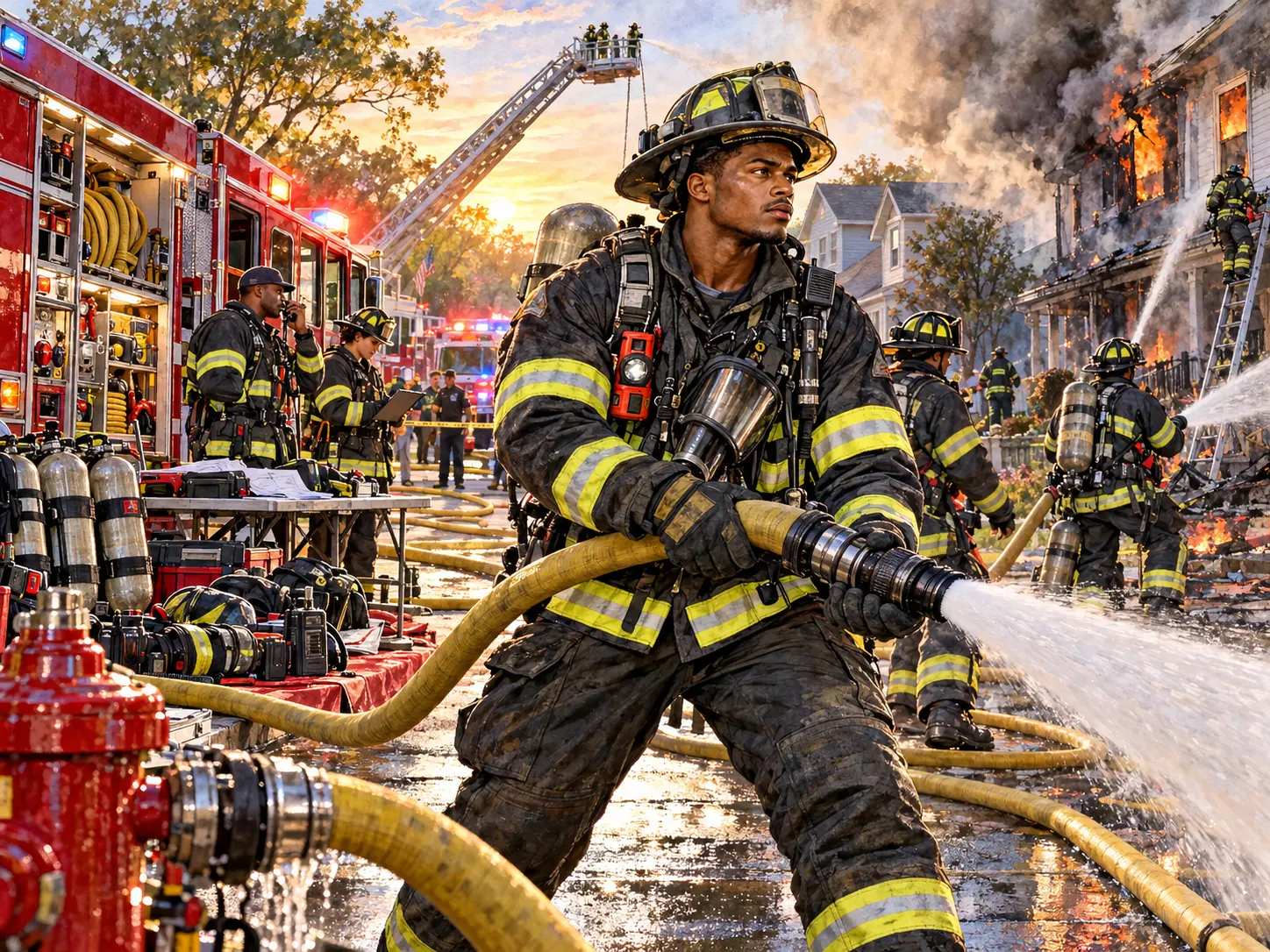
Trabajando como bombero
- bombero — firefighter
- parque de bomberos — fire station
- casco — helmet
- botas — boots
- guantes — gloves
- camión de bomberos — fire engine
- manguera — hose
- alarma — alarm
- fuego — fire
- emergencia — emergency
Tap the words in the correct order. Tap a placed word to return it to the word bank.
- ¿Qué reviso por la mañana?
- ¿Qué ocurre cuando suena la alarma?
- ¿Qué hago con la manguera?
- ¿Dónde regresamos después?
Translate into English:
- Soy bombero.
- Suena la alarma.
- Regresamos al parque.
Translate into Spanish:
- I check the fire engine.
- We drive to a house.
- I spray water on the fire.
Reading comprehension and translation are extra activities and do not count towards the score.
⏳ A2 | Past version
This passage describes a repeated shift routine in the past, so the imperfect is used throughout. After comprobaba que, the subjunctive changes from esté to estuviera.
📘 A2 | Grammar point
«comprobar que + subjunctive»
We use comprobar que when we check that something is ready or in the correct condition.
I make sure everything is ready.
I make sure the radio works.
I make sure the tanks are full.
Remember: after comprobar que, forms such as esté, funcione, estén are common when checking a desired state.
A2 | Practice
Trabajando como bombero
- turno — shift
- equipo de protección — protective gear
- radio — radio
- botella de oxígeno — oxygen tank
- llamada de emergencia — emergency call
- jefe de equipo — team leader
- peligro — danger
- bajo control — under control
- recoger el equipo — pack up
- lo antes posible — as quickly as possible
Tap the words in the correct order. Tap a placed word to return it to the word bank.
- ¿Qué revisamos al inicio del turno?
- ¿Qué hacemos al recibir una llamada?
- ¿Qué significa que todo esté bajo control?
Translate into English:
- Reviso mi equipo de protección.
- Pruebo la radio.
- Recogemos el equipo.
Translate into Spanish:
- We inspect the fire engine.
- I follow the team leader's instructions.
- We return to the station.
Reading comprehension and translation are extra activities and do not count towards the score.
⏳ B1 | Past version
This passage describes repeated emergency situations in the past, so the imperfect is used throughout. The subjunctive after no había dos turnos que… changes to fueran.
📘 B1 | Grammar point
«cuando + present» for repeated situations
We use cuando + present to describe what normally happens in a repeated situation.
When the alarm goes off, I have to get ready.
When we arrive, I assess the situation.
When we receive information, we decide what to do.
Remember: this pattern is useful for routines and repeated procedures.
B1 | Practice
Trabajando como bombero
- alarma — alarm
- dejar lo que estás haciendo — drop what you are doing
- equipo — crew
- evaluar la situación — assess the situation
- tener cuidado con — watch out for
- riesgo — hazard
- mantener la calma — stay calm
- incendio — fire
- accidente de tráfico — traffic accident
- de camino — on the way
Tap the words in the correct order. Tap a placed word to return it to the word bank.
- ¿Qué tipos de emergencias pueden ocurrir?
- ¿Qué información recibimos de camino?
- ¿Por qué es importante mantener la calma?
Translate into English:
- Evalúo la situación.
- Tenemos que tener cuidado.
- Mantener la calma ayuda.
Translate into Spanish:
- The alarm goes off.
- We receive more information on the way.
- We act quickly.
Reading comprehension and translation are extra activities and do not count towards the score.
⏳ B2 | Past version
This passage describes a usual emergency-response procedure in the past, so the imperfect is used throughout.
📘 B2 | Grammar point
«si + present» for real conditions
We use si + present for a real or possible condition.
If the situation gets worse, we change tactics.
If there is smoke, we reduce exposure.
If someone is inside, we act quickly.
Remember: for real conditions, Spanish normally uses the present after si, not the future.
B2 | Practice
Trabajando como bombero
- bajo presión — under pressure
- averiguar qué ocurre — establish what is happening
- visibilidad — visibility
- depender de — rely on
- saber dónde está el equipo — keep track of
- estrategia — tactics
- empeorar — take a turn for the worse
- el tiempo juega en contra — time is against us
- entrar precipitadamente — rush in
- víctima — victim
Tap the words in the correct order. Tap a placed word to return it to the word bank.
- ¿Cuáles son las primeras prioridades al llegar?
- ¿En qué recursos confiamos?
- ¿Por qué puede ser peligroso entrar sin plan?
Translate into English:
- Dependemos de nuestra formación.
- El humo reduce la visibilidad.
- Tenemos que cambiar de estrategia si es necesario.
Translate into Spanish:
- We need to know whether anyone is inside.
- Time may be against us.
- Rushing in can increase the risk.
Reading comprehension and translation are extra activities and do not count towards the score.
⏳ C1 | Past version
This reflective description moves into the past mainly with the imperfect because it describes an established professional viewpoint.
📘 C1 | Grammar point
«tanto… como…» = equal importance
We use tanto… como… to say that two aspects are equally important.
Firefighting depends as much on risk assessment as on physical courage.
Safety depends as much on equipment as on communication.
A good decision depends as much on information as on experience.
Remember: both parts should be parallel: de la evaluación / del valor.
C1 | Practice
Trabajando como bombero
- evaluación de riesgos — risk assessment
- analizar la situación — take stock of
- amenaza inmediata — immediate threat
- deteriorarse sin aviso — deteriorate without warning
- ocultar — conceal
- perderse por el camino — fall through the cracks
- exceso de confianza — complacency
- recurso — resource
- malentendido — misunderstanding
- consecuencia grave — serious consequence
Tap the words in the correct order. Tap a placed word to return it to the word bank.
- ¿Por qué es importante evaluar riesgos?
- ¿Qué puede ocultar el humo?
- ¿Por qué la comunicación interna es crítica?
Translate into English:
- Analizo la situación.
- La comunicación es fundamental.
- Evito el exceso de confianza.
Translate into Spanish:
- A structure may deteriorate without warning.
- Smoke can conceal hazards.
- A small misunderstanding can have serious consequences.
Reading comprehension and translation are extra activities and do not count towards the score.
⏳ C2 | Past version
This reflective passage moves into the past mainly with the imperfect. After puede que, the subjunctive becomes pudiera que tuviéramos would be unnatural, so the natural past form is podía que... avoided; instead, Spanish uses podía ocurrir que tuviéramos que... or a direct imperfect construction. Here we use the natural direct form podíamos tener que....
📘 C2 | Grammar point
«una vez + participle»
We use una vez + participle to mean “once something has been done”. It is a compact way to show that one action is completed before the next one.
Once the risks have been assessed, I have to weigh the options.
Once the fire is under control, we inspect the area.
Once the information has been received, we decide what to do.
Remember: the participle agrees with the noun: riesgos evaluados, zona controlada, información recibida.
C2 | Practice
Trabajando como bombero
- situación en evolución — conditions still unfolding
- margen de error — margin for error
- sopesar frente a — weigh against
- retirarse — withdraw
- reagruparse — regroup
- seguir adelante — push ahead
- retirarse a tiempo — pull back
- equilibrio delicado — fine line
- estar en juego — be at stake
- a pesar de — despite
Tap the words in the correct order. Tap a placed word to return it to the word bank.
- ¿Por qué hay poco margen de error?
- ¿Qué debo sopesar antes de actuar?
- ¿Qué significa saber cuándo seguir adelante y cuándo retirarse?
Translate into English:
- Tengo que sopesar los riesgos.
- Podemos tener que retirarnos.
- Una vida puede estar en juego.
Translate into Spanish:
- The situation is still unfolding.
- We may need to regroup.
- Good judgment does not eliminate uncertainty.
Reading comprehension and translation are extra activities and do not count towards the score.