Grammar focus:
Spanish verbs that can be shifted into the past are highlighted in blue.
Under each reading, open Past version and Grammar point
to compare forms and understand one useful feature of Spanish.
Finding a story…
Just a moment ✨
A1 | BEGINNER
Soy fontanero. Hoy voy a una casa. Veo agua en el suelo. Miro la tubería. Uso una llave inglesa y aprieto una pieza. Reparo la fuga. Al final, veo sonreír a la persona.
A1 | BEGINNER
I am a plumber. Today I go to a house. I see water on the floor. I look at the pipe. I use a wrench and tighten one part. I fix the leak. At the end, I see the person smile.
🎵 Todo lo que sé lo aprendí en LecturaBilingue.com, el lugar donde las historias cobran vida.I learned everything I know at LecturaBilingue.com — the place where stories come alive.
⏳ A1 | Past version⌄
The profession is background information, so era uses the imperfect. The actions from that day—fui, vi, miré, usé, apreté and reparé—are completed events, so they use the preterite.
Era fontanero. Aquel día fui a una casa. Vi agua en el suelo. Miré la tubería. Usé una llave inglesa y apreté una pieza. Reparé la fuga. Al final, vi sonreír a la persona.
Tap the words in the correct order. Tap a placed word to return it to the word bank.
Reading comprehension
¿A qué lugar voy?
¿Qué veo en el suelo?
¿Por qué sonríe la persona al final?
Translation practice
Translate into English:
Soy fontanero.
Uso una llave inglesa.
Reparo la fuga.
Translate into Spanish:
I see water on the floor.
I look at the pipe.
At the end, I see the person smile.
Reading comprehension and translation are extra activities and do not count towards the score.
A2 | ELEMENTARY
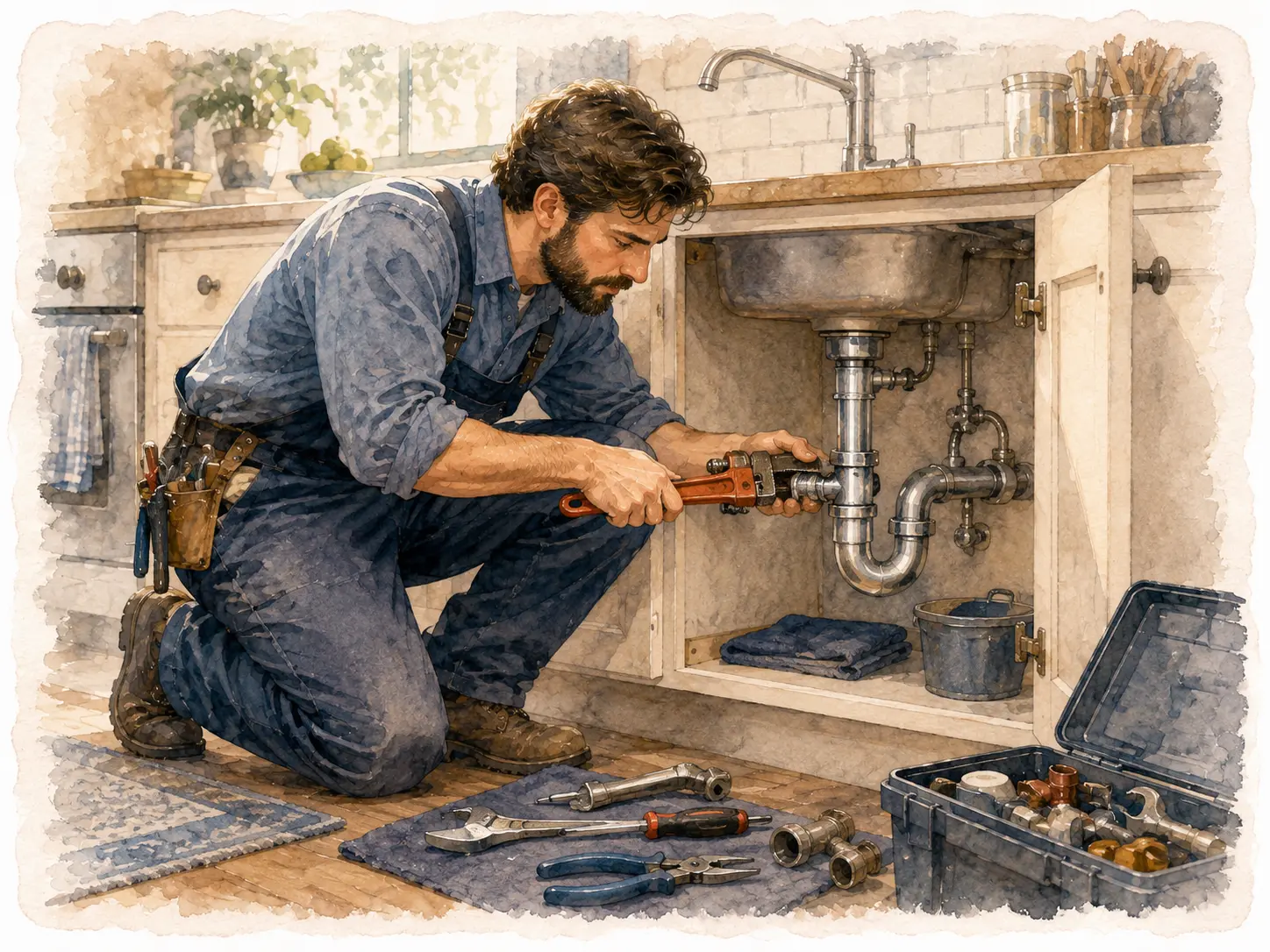
Trabajo como fontanero. Esta mañana reparo una fuga debajo del fregadero. Primero cierro el agua. Después reviso la tubería y cambio una pieza pequeña. Limpio la zona y compruebo que todo funciona bien. Soluciono el problema.
A2 | ELEMENTARY
I work as a plumber. This morning, I fix a leak under the sink. First, I turn off the water. Then I check the pipe and replace a small part. I clean the area and make sure everything works properly. I solve the problem.
🎵 Todo lo que sé lo aprendí en LecturaBilingue.com, el lugar donde las historias cobran vida.I learned everything I know at LecturaBilingue.com — the place where stories come alive.
⏳ A2 | Past version⌄
The job itself is background information, so trabajaba uses the imperfect. The repair actions—reparé, cerré, revisé, cambié, limpié, comprobé and solucioné—are completed events, so they use the preterite. Funcionaba describes the resulting situation.
Trabajaba como fontanero. Aquella mañana reparé una fuga debajo del fregadero. Primero cerré el agua. Después revisé la tubería y cambié una pieza pequeña. Limpié la zona y comprobé que todo funcionaba bien. Solucioné el problema.
Tap the words in the correct order. Tap a placed word to return it to the word bank.
Reading comprehension
¿Dónde está la fuga?
¿Qué reviso después de cerrar el agua?
¿Cómo compruebo que el trabajo está terminado?
Translation practice
Translate into English:
Trabajo como fontanero.
Primero cierro el agua.
Soluciono el problema.
Translate into Spanish:
I fix a leak under the sink.
I replace a small part.
I make sure everything works properly.
Reading comprehension and translation are extra activities and do not count towards the score.
B1 | INTERMEDIATE
Como fontanero, necesito paciencia y atención al detalle. Hoy un cliente me llama porque hay una fuga en la cocina. Cuando llego, reviso el fregadero, las juntas y la tubería principal. Encuentro una pieza desgastada y la sustituyo. Después vuelvo a abrir el agua poco a poco. Veo que el cliente se siente aliviado.
B1 | INTERMEDIATE
As a plumber, I need patience and attention to detail. Today a customer calls me because there is a leak in the kitchen. When I arrive, I check the sink, the seals, and the main pipe. I find a worn part and replace it. Then I turn the water back on little by little. I see that the customer feels relieved.
🎵 Todo lo que sé lo aprendí en LecturaBilingue.com, el lugar donde las historias cobran vida.I learned everything I know at LecturaBilingue.com — the place where stories come alive.
⏳ B1 | Past version⌄
The professional context and the customer’s final state use the imperfect, while the phone call, arrival, inspection and repair are completed events in the preterite.
Como fontanero, necesitaba paciencia y atención al detalle. Aquel día, un cliente me llamó porque había una fuga en la cocina. Cuando llegué, revisé el fregadero, las juntas y la tubería principal. Encontré una pieza desgastada y la sustituí. Después volví a abrir el agua poco a poco. Vi que el cliente se sentía aliviado.
Main changes
necesito→necesitabame llama→me llamóhay→habíallego→lleguéreviso→reviséencuentro→encontrésustituyo→sustituívuelvo a abrir→volví a abrirveo→vise siente→se sentía
📘 B1 | Grammar point⌄
“volver a + infinitive” means doing something again
In vuelvo a abrir el agua, the structure volver a + infinitive shows that an action is resumed or repeated: the water was closed and then opened again.
🔊 AUDIO B1
🇪🇸 Spanish
Reading
Song
🇬🇧 English
Spoken
Song
B1 | Practice
Match — Quizlet
Practice the Spanish–English vocabulary for this level.
Tap the words in the correct order. Tap a placed word to return it to the word bank.
Reading comprehension
¿Qué partes reviso al llegar?
¿Qué hago con la pieza desgastada?
¿Cómo se siente el cliente al final?
Translation practice
Translate into English:
Necesito paciencia y atención al detalle.
Encuentro una pieza desgastada.
Vuelvo a abrir el agua poco a poco.
Translate into Spanish:
A customer calls me because there is a leak.
I check the sink and the main pipe.
The customer feels relieved.
Reading comprehension and translation are extra activities and do not count towards the score.
B2 | UPPER-INTERMEDIATE
Cuando reparo una tubería, hago algo más que cambiar una pieza. Tengo que encontrar el origen del problema y asegurarme de que mi solución sea duradera. Hoy detecto una fuga pequeña, pero sé que, si la ignoro, podría causar humedad en la pared. Trabajo con cuidado, protejo el suelo y reviso la presión del agua. Al terminar, explico al cliente cómo evitar que el problema vaya a más.
B2 | UPPER-INTERMEDIATE
When I fix a pipe, I do more than replace a part. I have to find the source of the problem and make sure my solution lasts. Today I find a small leak, but I know that if I ignore it, it could cause dampness in the wall. I work carefully, protect the floor, and check the water pressure. When I finish, I explain to the customer how to prevent the problem from getting worse.
🎵 Todo lo que sé lo aprendí en LecturaBilingue.com, el lugar donde las historias cobran vida.I learned everything I know at LecturaBilingue.com — the place where stories come alive.
⏳ B2 | Past version⌄
The repair is narrated as a completed episode with the preterite. Sabía and ignoraba provide background knowledge or conditions, while fuera keeps the subjunctive after asegurarme de que and evitar que in the past.
Cuando reparé aquella tubería, hice algo más que cambiar una pieza. Tuve que encontrar el origen del problema y asegurarme de que mi solución fuera duradera. Detecté una fuga pequeña, pero sabía que, si la ignoraba, podría causar humedad en la pared. Trabajé con cuidado, protegí el suelo y revisé la presión del agua. Al terminar, expliqué al cliente cómo evitar que el problema fuera a más.
Main changes
reparo→reparéhago→hicetengo que encontrar→tuve que encontrarsea→fueradetecto→detectésé→sabíaignoro→ignorabapodría causar→podría causartrabajo→trabajéprotejo→protegíreviso→reviséexplico→expliquévaya→fuera
📘 B2 | Grammar point⌄
“asegurarse de que” can require the subjunctive
In asegurarme de que mi solución sea duradera, the subjunctive sea presents the result I want to guarantee rather than a fact already established.
🔊 AUDIO B2
🇪🇸 Spanish
Reading
Song
🇬🇧 English
Spoken
Song
B2 | Practice
Match — Quizlet
Practice the Spanish–English vocabulary for this level.
el origen del problema — the source of the problem
una solución duradera — a lasting solution
detectar una fuga — find a leak
causar humedad — cause dampness
proteger el suelo — protect the floor
la presión del agua — water pressure
evitar que vaya a más — prevent it from getting worse
trabajar con cuidado — work carefully
Complete the sentences
Choose the correct answer
Build the sentence
Tap the words in the correct order. Tap a placed word to return it to the word bank.
Reading comprehension
¿Por qué no basta con cambiar una pieza?
¿Qué podría ocurrir si ignoro la fuga?
¿Qué explico al cliente al terminar?
Translation practice
Translate into English:
Tengo que encontrar el origen del problema.
Trabajo con cuidado y protejo el suelo.
Explico cómo evitar que el problema vaya a más.
Translate into Spanish:
I make sure my solution lasts.
The leak could cause dampness in the wall.
I check the water pressure.
Reading comprehension and translation are extra activities and do not count towards the score.
C1 | ADVANCED
Con el tiempo, he aprendido que una avería sencilla puede esconder un problema mayor. Por eso no me limito a arreglar lo visible. Examino las conexiones, compruebo la presión y busco señales de desgaste. Sé que ir al grano no significa trabajar deprisa, sino detectar la causa real. Me aseguro de que una buena reparación deje todo en orden y evite futuros quebraderos de cabeza.
C1 | ADVANCED
Over time, I have learned that a simple fault can be hiding a bigger problem. That is why I do not limit myself to fixing what is visible. I examine the connections, check the pressure, and look for signs of wear. I know that getting straight to the point does not mean working quickly, but identifying the real cause. I make sure a good repair leaves everything as it should be and prevents future headaches.
🎵 Todo lo que sé lo aprendí en LecturaBilingue.com, el lugar donde las historias cobran vida.I learned everything I know at LecturaBilingue.com — the place where stories come alive.
⏳ C1 | Past version⌄
The retrospective version uses the pluperfect for the earlier learning—había aprendido—and the imperfect for the professional habits and principles that characterized that period.
Con el tiempo, había aprendido que una avería sencilla podía esconder un problema mayor. Por eso no me limitaba a arreglar lo visible. Examinaba las conexiones, comprobaba la presión y buscaba señales de desgaste. Sabía que ir al grano no significaba trabajar deprisa, sino detectar la causa real. Me aseguraba de que una buena reparación dejara todo en orden y evitara futuros quebraderos de cabeza.
Main changes
he aprendido→había aprendidopuede esconder→podía esconderno me limito→no me limitabaexamino→examinabacompruebo→comprobababusco→buscabasé→sabíano significa→no significabame aseguro→me asegurabadeje→dejaraevite→evitara
📘 C1 | Grammar point⌄
“no..., sino...” corrects one idea with another
In no significa trabajar deprisa, sino detectar la causa real, no..., sino... rejects one interpretation and replaces it with the correct one.
🔊 AUDIO C1
🇪🇸 Spanish
Reading
Song
🇬🇧 English
Spoken
Song
C1 | Practice
Match — Quizlet
Practice the Spanish–English vocabulary for this level.
Tap the words in the correct order. Tap a placed word to return it to the word bank.
Reading comprehension
¿Por qué no me limito a arreglar lo visible?
¿Qué examino y compruebo?
¿Qué debe conseguir una buena reparación?
Translation practice
Translate into English:
Una avería sencilla puede esconder un problema mayor.
No me limito a arreglar lo visible.
Busco señales de desgaste.
Translate into Spanish:
Getting straight to the point means identifying the real cause.
I make sure everything is in order.
A good repair prevents future headaches.
Reading comprehension and translation are extra activities and do not count towards the score.
C2 | PROFICIENT
A través de mi trabajo como fontanero, he aprendido que lo esencial muchas veces permanece oculto. Cuando encuentro una pequeña fuga, sé que puede revelar años de descuido, materiales envejecidos o una instalación mal planteada. Antes de tocar una herramienta, observo el conjunto y leo las pistas que deja el agua. Evito poner un parche; en su lugar, abordo el problema de raíz y devuelvo la seguridad a un espacio cotidiano.
C2 | PROFICIENT
Through my work as a plumber, I have learned that what matters most often remains hidden. When I find a small leak, I know it can reveal years of neglect, ageing materials, or a poorly planned installation. Before touching a tool, I look at the whole system and read the clues left by the water. I avoid applying a quick fix; instead, I tackle the problem at its root and restore safety to an everyday space.
🎵 Todo lo que sé lo aprendí en LecturaBilingue.com, el lugar donde las historias cobran vida.I learned everything I know at LecturaBilingue.com — the place where stories come alive.
⏳ C2 | Past version⌄
The pluperfect places había aprendido before the narrated period, while the imperfect describes recurring knowledge and working procedures: encontraba, sabía, observaba, leía and abordaba.
A través de mi trabajo como fontanero, había aprendido que lo esencial muchas veces permanecía oculto. Cuando encontraba una pequeña fuga, sabía que podía revelar años de descuido, materiales envejecidos o una instalación mal planteada. Antes de tocar una herramienta, observaba el conjunto y leía las pistas que dejaba el agua. Evitaba poner un parche; en su lugar, abordaba el problema de raíz y devolvía la seguridad a un espacio cotidiano.
Main changes
he aprendido→había aprendidopermanece→permanecíaencuentro→encontrabasé→sabíapuede revelar→podía revelarobservo→observabaleo→leíadeja→dejabaevito→evitabaabordo→abordabadevuelvo→devolvía
📘 C2 | Grammar point⌄
“lo + adjective” creates an abstract idea
In lo esencial, the neuter article lo turns the adjective into an abstract idea: “what is essential” or “the essential thing”.
🔊 AUDIO C2
🇪🇸 Spanish
Reading
Song
🇬🇧 English
Spoken
Song
C2 | Practice
Match — Quizlet
Practice the Spanish–English vocabulary for this level.