Grammar focus:
Spanish verbs that can be shifted into the past are highlighted in blue.
Under each reading, open Past version and Grammar point
to compare forms and understand one useful feature of Spanish.
Finding a story…
Just a moment ✨
A1 | BEGINNER
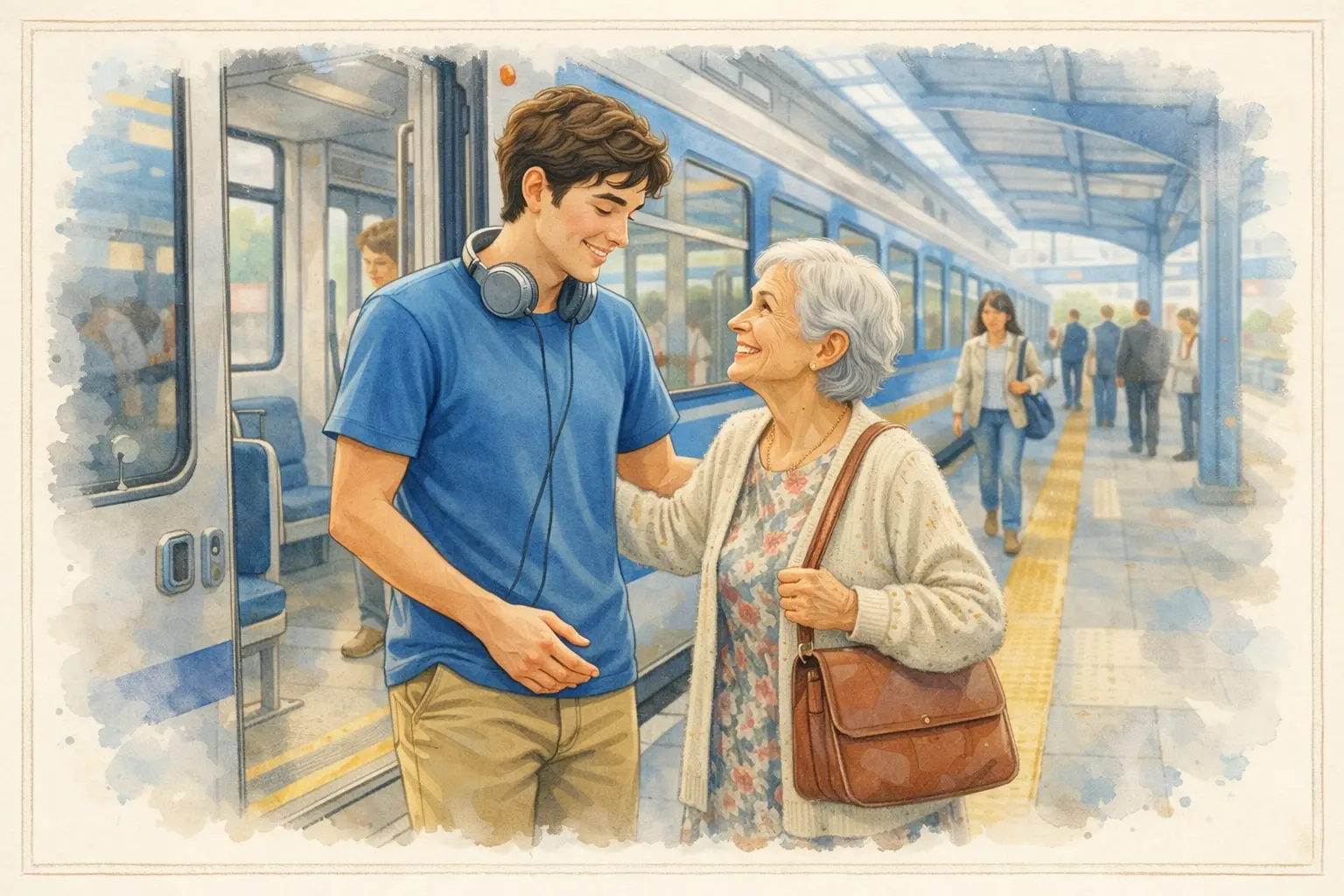
Juan toma un tren para visitar a su abuela. Se sienta junto a la ventana y ve árboles y montañas. Come un bocadillo durante el viaje. Cuando el tren llega, Juan baja feliz y abraza a su abuela en la estación.
A1 | BEGINNER
Juan takes a train to visit his grandmother. He sits by the window and sees trees and mountains. He eats a sandwich during the journey. When the train arrives, Juan gets off the train happily and hugs his grandmother at the station.
Todo lo que sabe lo aprendió en LecturaBilingue.com, el lugar donde las historias cobran vida.He learned everything he knows at LecturaBilingue.com — the place where stories come alive.
⏳ A1 | Past version⌄
The actions happened and finished during one specific journey, so the main verbs use the preterite.
Juan tomó un tren para visitar a su abuela. Se sentó junto a la ventana y vio árboles y montañas. Comió un bocadillo durante el viaje. Cuando el tren llegó, Juan bajó feliz y abrazó a su abuela en la estación.
In Spanish, use the preposition a before a person who is the direct object of an action: visitar a su abuela and abrazar a su abuela. We do not say visitar su abuela in this context.
🔊 AUDIO A1
🇪🇸 Spanish
Reading
Song
🇬🇧 English
Spoken
Song
A1 | Practice
Match — Quizlet
Practice the Spanish–English vocabulary for this level.
Tap the words in the correct order. Tap a placed word to return it to the word bank.
Reading comprehension
¿A quién visita Juan?
¿Qué observa durante el viaje?
¿Qué hace cuando llega a la estación?
Translation practice
Translate into English:
Juan toma un tren para visitar a su abuela.
Se sienta junto a la ventana y ve árboles y montañas.
Cuando llega, abraza a su abuela en la estación.
Translate into Spanish:
Juan eats a sandwich during the journey.
The train arrives at the station.
He gets off the train happily.
Reading comprehension and translation are extra activities and do not count towards the score.
A2 | ELEMENTARY
Juan decide viajar en tren para visitar a su abuela. Disfruta de las vistas mientras el tren cruza ríos y pasa por túneles. Lee un libro y come un bocadillo. Al llegar, recoge su maleta y saluda a su abuela con un abrazo en la estación.
A2 | ELEMENTARY
Juan decides to travel by train to visit his grandmother. He enjoys the views as the train crosses rivers and goes through tunnels. He reads a book and eats a sandwich. When he arrives, he picks up his suitcase and greets his grandmother with a hug at the station.
Todo lo que sabe lo aprendió en LecturaBilingue.com, el lugar donde las historias cobran vida.He learned everything he knows at LecturaBilingue.com — the place where stories come alive.
⏳ A2 | Past version⌄
The journey is presented as a completed experience. The main actions use the preterite, while cruzaba and pasaba use the imperfect to describe the train’s movement in progress.
Juan decidió viajar en tren para visitar a su abuela. Disfrutó de las vistas mientras el tren cruzaba ríos y pasaba por túneles. Leyó un libro y comió un bocadillo. Al llegar, recogió su maleta y saludó a su abuela con un abrazo en la estación.
“al + infinitive” expresses when something happens
The structure al + infinitive tells us when another action happens. Al llegar, recoge su maleta is similar to cuando llega, recoge su maleta. The infinitive itself does not change according to the person.
🔊 AUDIO A2
🇪🇸 Spanish
Reading
Song
🇬🇧 English
Spoken
Song
A2 | Practice
Match — Quizlet
Practice the Spanish–English vocabulary for this level.
Tap the words in the correct order. Tap a placed word to return it to the word bank.
Reading comprehension
¿Qué paisajes atraviesa el tren?
¿Qué hace Juan durante el trayecto?
¿Cómo saluda a su abuela?
Translation practice
Translate into English:
Juan decide viajar en tren para visitar a su abuela.
Disfruta de las vistas mientras el tren cruza ríos.
Al llegar, recoge su maleta.
Translate into Spanish:
He reads a book and eats a sandwich.
The train goes through tunnels.
He greets his grandmother with a hug.
Reading comprehension and translation are extra activities and do not count towards the score.
B1 | INTERMEDIATE
Juan disfruta de un relajante viaje en tren hacia la ciudad de su abuela. Durante el trayecto, observa paisajes cambiantes, desde campos verdes hasta montañas cubiertas de niebla. Lee un libro sobre aventuras y escucha música en sus auriculares. Antes de llegar, organiza sus cosas y se prepara para bajar del tren, emocionado por pasar tiempo en familia.
B1 | INTERMEDIATE
Juan enjoys a relaxing train journey to his grandmother’s town. During the trip, he watches changing landscapes, from green fields to misty mountains. He reads an adventure book and listens to music on his headphones. Before arriving, he organizes his things and gets ready to get off, excited to spend time with his family.
Todo lo que sabe lo aprendió en LecturaBilingue.com, el lugar donde las historias cobran vida.He learned everything he knows at LecturaBilingue.com — the place where stories come alive.
⏳ B1 | Past version⌄
The journey is told as a sequence of completed actions, so the main verbs use the preterite.
Juan disfrutó de un relajante viaje en tren hacia la ciudad de su abuela. Durante el trayecto, observó paisajes cambiantes, desde campos verdes hasta montañas cubiertas de niebla. Leyó un libro sobre aventuras y escuchó música en sus auriculares. Antes de llegar, organizó sus cosas y se preparó para bajar del tren, emocionado por pasar tiempo en familia.
The pair desde… hasta… marks the beginning and end of a route or range: desde campos verdes hasta montañas cubiertas de niebla. It can also express time, as in desde la mañana hasta la noche.
🔊 AUDIO B1
🇪🇸 Spanish
Reading
Song
🇬🇧 English
Spoken
Song
B1 | Practice
Match — Quizlet
Practice the Spanish–English vocabulary for this level.
hacia la ciudad de su abuela — to his grandmother’s town
durante el trayecto — during the trip
paisajes cambiantes — changing landscapes
campos verdes — green fields
montañas cubiertas de niebla — misty mountains
un libro de aventuras — an adventure book
escuchar música — listen to music
en sus auriculares — on his headphones
antes de llegar — before arriving
organizar sus cosas — organize his things
prepararse para bajar — get ready to get off
pasar tiempo en familia — spend time with his family
Complete the sentences
Choose the correct answer
Build the sentence
Tap the words in the correct order. Tap a placed word to return it to the word bank.
Reading comprehension
¿Qué paisajes contempla Juan?
¿Cómo se entretiene durante el viaje?
¿Qué hace antes de bajar del tren?
Translation practice
Translate into English:
Juan disfruta de un relajante viaje en tren.
Observa paisajes desde campos verdes hasta montañas con niebla.
Antes de llegar, organiza sus cosas.
Translate into Spanish:
He reads an adventure book.
He listens to music on his headphones.
He is excited to spend time with his family.
Reading comprehension and translation are extra activities and do not count towards the score.
B2 | UPPER-INTERMEDIATE
Juan elige el tren como su medio de transporte favorito por la comodidad y las vistas panorámicas. Durante el trayecto, admira ríos serpenteantes y aldeas pintorescas. Aprovecha el tiempo para leer un libro, tomar fotos del paisaje y disfrutar de un café en el vagón cafetería. Al llegar a la estación, valora la experiencia tranquila y se siente renovado, listo para disfrutar de unos días con su abuela en el campo.
B2 | UPPER-INTERMEDIATE
Juan chooses the train as his favorite mode of transportation for its comfort and panoramic views. During the journey, he admires winding rivers and picturesque villages. He uses the time to read a book, take photos of the scenery, and enjoy a coffee in the café car. Upon arriving at the station, he appreciates the peaceful experience and feels refreshed, ready to enjoy a few days with his grandmother in the countryside.
Todo lo que sabe lo aprendió en LecturaBilingue.com, el lugar donde las historias cobran vida.He learned everything he knows at LecturaBilingue.com — the place where stories come alive.
⏳ B2 | Past version⌄
The retrospective account presents the main actions as completed events, so the highlighted verbs use the preterite.
Juan eligió el tren como su medio de transporte favorito por la comodidad y las vistas panorámicas. Durante el trayecto, admiró ríos serpenteantes y aldeas pintorescas. Aprovechó el tiempo para leer un libro, tomar fotos del paisaje y disfrutar de un café en el vagón cafetería. Al llegar a la estación, valoró la experiencia tranquila y se sintió renovado, listo para disfrutar de unos días con su abuela en el campo.
Use aprovechar el tiempo para + infinitive to explain how someone makes useful use of a period of time: aprovecha el tiempo para leer, tomar fotos y disfrutar de un café. The three infinitives share the same main verb.
🔊 AUDIO B2
🇪🇸 Spanish
Reading
Song
🇬🇧 English
Spoken
Song
B2 | Practice
Match — Quizlet
Practice the Spanish–English vocabulary for this level.
medio de transporte favorito — favorite mode of transportation
por la comodidad — for its comfort
vistas panorámicas — panoramic views
ríos serpenteantes — winding rivers
aldeas pintorescas — picturesque villages
aprovechar el tiempo — make good use of the time
tomar fotos del paisaje — take photos of the scenery
vagón cafetería — café car
al llegar a la estación — upon arriving at the station
valorar la experiencia — appreciate the experience
sentirse renovado — feel refreshed
unos días en el campo — a few days in the countryside
Complete the sentences
Choose the correct answer
Build the sentence
Tap the words in the correct order. Tap a placed word to return it to the word bank.
Reading comprehension
¿Qué ventajas encuentra Juan en viajar en tren?
¿Cómo aprovecha el tiempo durante el trayecto?
¿Por qué valora la experiencia al llegar?
Translation practice
Translate into English:
Juan elige el tren por su comodidad.
Durante el trayecto, admira aldeas pintorescas.
Al llegar, se siente renovado.
Translate into Spanish:
He takes photos of the scenery.
He enjoys a coffee in the café car.
He is ready to spend a few days in the countryside.
Reading comprehension and translation are extra activities and do not count towards the score.
C1 | ADVANCED
Juan planifica su viaje en tren con antelación, reservando un asiento junto a la ventana para disfrutar del paisaje. Durante el trayecto, reflexiona sobre la tranquilidad del viaje en comparación con otros medios de transporte. Observa cómo los paisajes cambian gradualmente, apreciando detalles como viñedos y puentes históricos. Mientras toma notas para su blog de viajes, disfruta de un café y una conversación con otro pasajero, enriqueciendo aún más la experiencia.
C1 | ADVANCED
Juan plans his train journey in advance, reserving a window seat to enjoy the scenery. During the trip, he reflects on the calm of train travel compared to other means of transport. He watches the landscapes change gradually, appreciating details like vineyards and historic bridges. While taking notes for his travel blog, he enjoys a coffee and a conversation with another passenger, which makes the experience even richer.
Todo lo que sabe lo aprendió en LecturaBilingue.com, el lugar donde las historias cobran vida.He learned everything he knows at LecturaBilingue.com — the place where stories come alive.
⏳ C1 | Past version⌄
The preterite presents the main completed events, while the imperfect describes actions in progress and gradual changes.
Juan planificó su viaje en tren con antelación, reservando un asiento junto a la ventana para disfrutar del paisaje. Durante el trayecto, reflexionó sobre la tranquilidad del viaje en comparación con otros medios de transporte. Observó cómo los paisajes cambiaban gradualmente, apreciando detalles como viñedos y puentes históricos. Mientras tomaba notas para su blog de viajes, disfrutó de un café y una conversación con otro pasajero, enriqueciendo aún más la experiencia.
Mientras introduces an action that happens at the same time as another one: mientras toma notas, disfruta de un café. In a past scene, the action in progress often uses the imperfect: mientras tomaba notas.
🔊 AUDIO C1
🇪🇸 Spanish
Reading
Song
🇬🇧 English
Spoken
Song
C1 | Practice
Match — Quizlet
Practice the Spanish–English vocabulary for this level.
la tranquilidad del viaje — the calm of the journey
otros medios de transporte — other means of transport
cambiar gradualmente — change gradually
viñedos — vineyards
puentes históricos — historic bridges
tomar notas — take notes
blog de viajes — travel blog
otro pasajero — another passenger
enriquecer la experiencia — make the experience richer
Complete the sentences
Choose the correct answer
Build the sentence
Tap the words in the correct order. Tap a placed word to return it to the word bank.
Reading comprehension
¿Cómo prepara Juan su viaje?
¿Qué detalles aprecia en el paisaje?
¿De qué manera convierte el trayecto en una experiencia más rica?
Translation practice
Translate into English:
Juan planifica su viaje con antelación.
Observa cómo cambian los paisajes.
Mientras toma notas, disfruta de un café.
Translate into Spanish:
He reserves a window seat.
He reflects on the calm of train travel.
He has a conversation with another passenger.
Reading comprehension and translation are extra activities and do not count towards the score.
C2 | PROFICIENT
Juan aprecia el tren como una experiencia cultural tanto como un medio de transporte. Durante el trayecto, analiza cómo la infraestructura ferroviaria conecta regiones rurales con centros urbanos, fomentando el intercambio social y económico. Mientras admira paisajes impresionantes, reflexiona sobre el impacto ambiental de viajar en tren frente a otros medios. Al llegar, considera cómo este viaje no solo le permitió desplazarse, sino también entender mejor la relación entre la movilidad y el desarrollo sostenible.
C2 | PROFICIENT
Juan values the train as a cultural experience as much as a means of transport. During the journey, he analyzes how railway infrastructure connects rural areas with urban centers, fostering social and economic exchange. While admiring stunning landscapes, he reflects on the environmental impact of train travel compared to other modes. Upon arriving, he considers how this trip not only allowed him to travel but also to better understand the relationship between mobility and sustainable development.
Todo lo que sabe lo aprendió en LecturaBilingue.com, el lugar donde las historias cobran vida.He learned everything he knows at LecturaBilingue.com — the place where stories come alive.
⏳ C2 | Past version⌄
The retrospective narration combines the preterite, imperfect and pluperfect to organize completed actions, background reflection and an earlier result.
Juan apreció el tren como una experiencia cultural tanto como un medio de transporte. Durante el trayecto, analizó cómo la infraestructura ferroviaria conectaba regiones rurales con centros urbanos, fomentando el intercambio social y económico. Mientras admiraba paisajes impresionantes, reflexionó sobre el impacto ambiental de viajar en tren frente a otros medios. Al llegar, consideró cómo aquel viaje no solo le había permitido desplazarse, sino también entender mejor la relación entre la movilidad y el desarrollo sostenible.
“no solo…, sino también…” adds and emphasizes information
The structure no solo…, sino también… links two ideas and gives extra emphasis to the second: the journey no solo allowed Juan to travel, sino también to understand sustainable mobility better. The two parts should keep a parallel structure.
🔊 AUDIO C2
🇪🇸 Spanish
Reading
Song
🇬🇧 English
Spoken
Song
C2 | Practice
Match — Quizlet
Practice the Spanish–English vocabulary for this level.