Grammar focus:
Spanish verbs that can be shifted into the past are highlighted in blue.
Under each reading, open Past version and Grammar point
to compare forms and understand one useful feature of Spanish.
Finding a story…
Just a moment ✨
A1 | BEGINNER
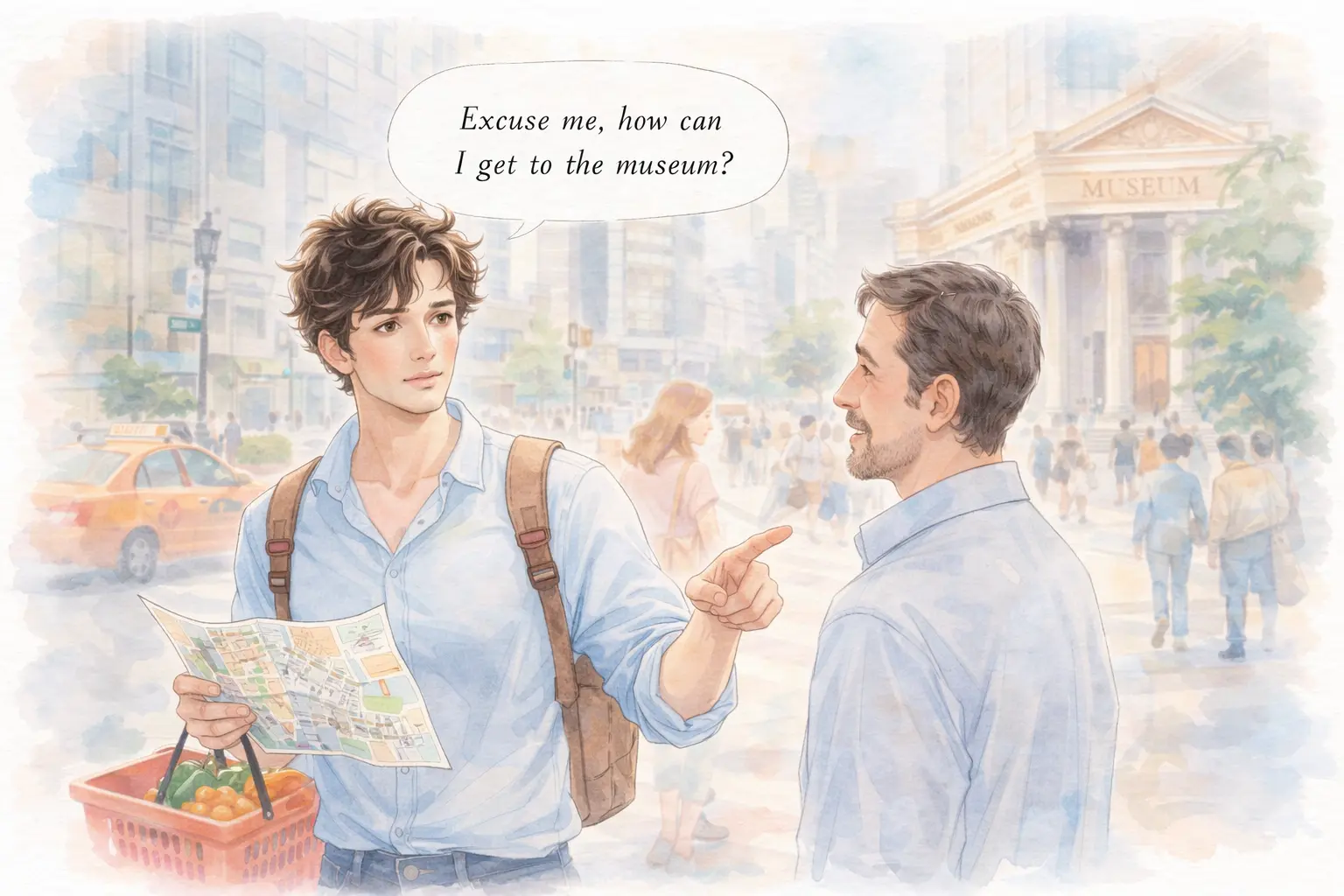
Javier visita una ciudad nueva. Camina por las calles y ve muchos edificios altos. Quiere encontrar un museo, pero no sabe dónde está. Se acerca a una persona y le pregunta. Al final, sigue las indicaciones y llega al museo contento.
A1 | BEGINNER
Javier visits a new city. He walks through the streets and sees many tall buildings. He wants to find a museum, but he doesn’t know where it is. He goes up to someone and asks them. In the end, he follows the directions and arrives at the museum happy.
🎵 Todo lo que sabe lo aprendió en LecturaBilingue.com, el lugar donde las historias cobran vida.He learned everything he knows at LecturaBilingue.com — the place where stories come alive.
⏳ A1 | Past version⌄
The main actions shift to the preterite. The imperfect in no sabía dónde estaba describes the situation that existed at that moment.
Javier visitó una ciudad nueva. Caminó por las calles y vio muchos edificios altos. Quiso encontrar un museo, pero no sabía dónde estaba. Se acercó a una persona y le preguntó. Al final, siguió las indicaciones y llegó al museo contento.
In no sabe dónde está, dónde has a written accent because it introduces an indirect question. It does not need question marks here, but it keeps the meaning of ¿dónde está?.
🔊 AUDIO A1
🇪🇸 Spanish
Reading
Song
🇬🇧 English
Spoken
Song
A1 | Practice
Match — Quizlet
Practice the Spanish–English vocabulary for this level.
Tap the words in the correct order. Tap a placed word to return it to the word bank.
Reading comprehension
¿Qué ve Javier mientras camina por la ciudad?
¿Por qué se acerca a otra persona?
¿Cómo se siente cuando llega al museo?
Translation practice
Translate into English:
Javier visita una ciudad nueva.
No sabe dónde está el museo.
Al final, sigue las indicaciones y llega contento.
Translate into Spanish:
He walks through the streets.
He sees many tall buildings.
He asks someone for directions.
Reading comprehension and translation are extra activities and do not count towards the score.
A2 | ELEMENTARY
Javier viaja solo por primera vez y decide explorar la ciudad. Usa un mapa, pero se pierde y da vueltas por las mismas calles. Pide indicaciones a un hombre amable, quien le señala el camino al museo. Después de unos minutos, encuentra su destino y aprende a orientarse mejor.
A2 | ELEMENTARY
Javier travels alone for the first time and decides to explore the city. He uses a map but gets lost and walks around the same streets. He asks a kind man for directions, and the man points him towards the museum. After a few minutes, he finds his destination and learns to navigate better.
🎵 Todo lo que sabe lo aprendió en LecturaBilingue.com, el lugar donde las historias cobran vida.He learned everything he knows at LecturaBilingue.com — the place where stories come alive.
⏳ A2 | Past version⌄
All the completed actions shift to the preterite. The relative structure with quien stays unchanged.
Javier viajó solo por primera vez y decidió explorar la ciudad. Usó un mapa, pero se perdió y dio vueltas por las mismas calles. Pidió indicaciones a un hombre amable, quien le señaló el camino al museo. Después de unos minutos, encontró su destino y aprendió a orientarse mejor.
In un hombre amable, quien le señala el camino, quien refers back to a person already mentioned and adds extra information about him. After a comma, it is similar in meaning to el cual.
🔊 AUDIO A2
🇪🇸 Spanish
Reading
Song
🇬🇧 English
Spoken
Song
A2 | Practice
Match — Quizlet
Practice the Spanish–English vocabulary for this level.
Tap the words in the correct order. Tap a placed word to return it to the word bank.
Reading comprehension
¿Por qué da vueltas por las mismas calles?
¿Qué hace el hombre amable?
¿Qué aprende Javier al final?
Translation practice
Translate into English:
Javier viaja solo por primera vez.
Usa un mapa, pero se pierde.
Encuentra su destino después de unos minutos.
Translate into Spanish:
He decides to explore the city.
He asks a kind man for directions.
He learns to navigate better.
Reading comprehension and translation are extra activities and do not count towards the score.
B1 | INTERMEDIATE
Javier disfruta descubriendo nuevas ciudades, pero hoy se ha equivocado de camino. Usa su GPS, pero la señal es débil. Se acerca a una persona de allí, quien le recomienda una aplicación de transporte público. Mientras camina hacia la estación de metro, observa la arquitectura y hace fotos. Al final, llega al museo y se siente más seguro viajando solo.
B1 | INTERMEDIATE
Javier enjoys discovering new cities, but today he has taken a wrong turn. He uses his GPS, but the signal is weak. He approaches a local, who recommends a public transport app. As he walks toward the metro station, he observes the architecture and takes pictures. In the end, he reaches the museum and feels more confident traveling alone.
🎵 Todo lo que sabe lo aprendió en LecturaBilingue.com, el lugar donde las historias cobran vida.He learned everything he knows at LecturaBilingue.com — the place where stories come alive.
⏳ B1 | Past version⌄
Once the whole experience is placed in a day that has already ended, the pluperfect marks the earlier mistake, the imperfect gives background context, and the preterite narrates the main actions.
Javier disfrutaba descubriendo nuevas ciudades, pero aquel día se había equivocado de camino. Usó su GPS, pero la señal era débil. Se acercó a una persona de allí, quien le recomendó una aplicación de transporte público. Mientras caminaba hacia la estación de metro, observó la arquitectura e hizo fotos. Al final, llegó al museo y se sintió más seguro viajando solo.
Main changes
disfruta→disfrutabahoy→aquel díase ha equivocado→se había equivocadoUsa→Usóes→eraSe acerca→Se acercórecomienda→recomendócamina→caminabaobserva→observóhace→hizollega→llegóse siente→se sintió
📘 B1 | Grammar point⌄
The present perfect with “hoy”
In hoy se ha equivocado de camino, Spanish uses the present perfect because the action happened within a time period that has not finished yet: hoy. Its consequence is still relevant in the present.
🔊 AUDIO B1
🇪🇸 Spanish
Reading
Song
🇬🇧 English
Spoken
Song
B1 | Practice
Match — Quizlet
Practice the Spanish–English vocabulary for this level.
observar la arquitectura — observe the architecture
hacer fotos — take pictures
llegar al museo — reach the museum
sentirse más seguro — feel more confident
viajar solo — travel alone
Complete the sentences
Choose the correct answer
Build the sentence
Tap the words in the correct order. Tap a placed word to return it to the word bank.
Reading comprehension
¿Por qué se acerca Javier a una persona de allí?
¿Qué descubre mientras camina hacia el metro?
¿Por qué se siente más seguro al final?
Translation practice
Translate into English:
Javier disfruta descubriendo nuevas ciudades.
La señal del GPS es débil.
Al final, llega al museo y se siente más seguro.
Translate into Spanish:
A local recommends a public transport app.
He observes the architecture and takes pictures.
He feels more confident traveling alone.
Reading comprehension and translation are extra activities and do not count towards the score.
B2 | UPPER-INTERMEDIATE
Javier ha viajado a muchas ciudades, pero esta vez decide explorar sin depender del GPS. Mientras pasea, se da cuenta de que ha tomado el camino equivocado. En lugar de entrar en pánico, pregunta a un transeúnte y sigue sus indicaciones. En el trayecto, se topa con una librería encantadora y una cafetería con música en directo. Su pequeño error lo lleva a una experiencia inesperada y enriquecedora.
B2 | UPPER-INTERMEDIATE
Javier has traveled to many cities, but this time he decides to explore without relying on GPS. As he strolls around, he realizes he has taken the wrong path. Instead of panicking, he asks a passerby and follows their directions. Along the way, he comes across a charming bookstore and a café with live music. His small mistake leads to an unexpected and enriching experience.
🎵 Todo lo que sabe lo aprendió en LecturaBilingue.com, el lugar donde las historias cobran vida.He learned everything he knows at LecturaBilingue.com — the place where stories come alive.
⏳ B2 | Past version⌄
The pluperfect expresses experiences and actions that happened earlier. The preterite narrates the specific decisions and discoveries from that walk.
Javier había viajado a muchas ciudades, pero aquella vez decidió explorar sin depender del GPS. Mientras paseaba, se dio cuenta de que había tomado el camino equivocado. En lugar de entrar en pánico, preguntó a un transeúnte y siguió sus indicaciones. En el trayecto, se topó con una librería encantadora y una cafetería con música en directo. Su pequeño error lo llevó a una experiencia inesperada y enriquecedora.
Main changes
ha viajado→había viajadoesta vez→aquella vezdecide→decidiópasea→paseabase da cuenta→se dio cuentaha tomado→había tomadopregunta→preguntósigue→siguióse topa→se topólleva→llevó
📘 B2 | Grammar point⌄
“en lugar de” + infinitive
The structure en lugar de + infinitive presents an alternative: en lugar de entrar en pánico, pregunta a un transeúnte. Javier chooses one action instead of doing the other.
🔊 AUDIO B2
🇪🇸 Spanish
Reading
Song
🇬🇧 English
Spoken
Song
B2 | Practice
Match — Quizlet
Practice the Spanish–English vocabulary for this level.
Tap the words in the correct order. Tap a placed word to return it to the word bank.
Reading comprehension
¿Por qué quiere explorar sin depender del GPS?
¿Qué hace cuando descubre que se ha equivocado?
¿Cómo transforma el error en una experiencia positiva?
Translation practice
Translate into English:
Javier decide explorar sin depender del GPS.
Pregunta a un transeúnte y sigue sus indicaciones.
Su pequeño error lo lleva a una experiencia enriquecedora.
Translate into Spanish:
He realizes he has taken the wrong path.
He comes across a charming bookstore.
The café has live music.
Reading comprehension and translation are extra activities and do not count towards the score.
C1 | ADVANCED
Javier se enfrenta al reto de moverse por una ciudad desconocida sin depender de la tecnología. Para practicar el idioma, pide indicaciones a varias personas y compara sus respuestas. Nota diferencias culturales en la manera en que la gente da indicaciones. En su camino al museo, se cruza con una feria callejera y decide dar un rodeo. Se da cuenta de que perderse es, a veces, la mejor forma de descubrir un lugar.
C1 | ADVANCED
Javier faces the challenge of moving around an unfamiliar city without relying on technology. To practice the language, he asks several people for directions and compares their responses. He notices cultural differences in how people give directions. On his way to the museum, he comes across a street fair and decides to take a detour. He realizes that getting lost is sometimes the best way to discover a place.
🎵 Todo lo que sabe lo aprendió en LecturaBilingue.com, el lugar donde las historias cobran vida.He learned everything he knows at LecturaBilingue.com — the place where stories come alive.
⏳ C1 | Past version⌄
The preterite presents completed actions. The imperfect in la gente daba indicaciones and perderse era describes background behavior and ideas.
Javier se enfrentó al reto de moverse por una ciudad desconocida sin depender de la tecnología. Para practicar el idioma, pidió indicaciones a varias personas y comparó sus respuestas. Notó diferencias culturales en la manera en que la gente daba indicaciones. En su camino al museo, se cruzó con una feria callejera y decidió dar un rodeo. Se dio cuenta de que perderse era, a veces, la mejor forma de descubrir un lugar.
Main changes
se enfrenta→se enfrentópide→pidiócompara→comparóNota→Notóda→dabase cruza→se cruzódecide→decidióSe da cuenta→Se dio cuentaes→era
📘 C1 | Grammar point⌄
“la manera en que”
The expression la manera en que introduces the way something happens: Javier notices cultural differences in la manera en que la gente da indicaciones. Spanish can also use la forma en que.
🔊 AUDIO C1
🇪🇸 Spanish
Reading
Song
🇬🇧 English
Spoken
Song
C1 | Practice
Match — Quizlet
Practice the Spanish–English vocabulary for this level.
Tap the words in the correct order. Tap a placed word to return it to the word bank.
Reading comprehension
¿Qué aprende al comparar las indicaciones de distintas personas?
¿Por qué decide desviarse de su camino?
¿Qué valor descubre en el hecho de perderse?
Translation practice
Translate into English:
Javier se enfrenta al reto de moverse sin tecnología.
Compara las respuestas de varias personas.
Perderse puede ser la mejor forma de descubrir un lugar.
Translate into Spanish:
He notices cultural differences in how people give directions.
He comes across a street fair.
He decides to take a detour.
Reading comprehension and translation are extra activities and do not count towards the score.
C2 | PROFICIENT
Javier experimenta la ciudad con un enfoque filosófico, observando cómo el diseño urbano influye en la dinámica social. En lugar de preocuparse por perderse, se deja llevar por el entorno y analiza cómo los espacios públicos moldean la interacción humana. Reflexiona sobre cómo la forma en que las ciudades están construidasafecta al comportamiento de sus habitantes. Al final, concluye que la exploración sin rumbo es un arte en sí mismo.
C2 | PROFICIENT
Javier experiences the city with a philosophical approach, observing how urban design influences social dynamics. Instead of worrying about getting lost, he lets himself be guided by his surroundings and analyzes how public spaces shape human interaction. He reflects on how the way cities are built affects the behavior of their inhabitants. In the end, he concludes that aimless exploration is an art in itself.
🎵 Todo lo que sabe lo aprendió en LecturaBilingue.com, el lugar donde las historias cobran vida.He learned everything he knows at LecturaBilingue.com — the place where stories come alive.
⏳ C2 | Past version⌄
The preterite narrates Javier’s specific experience. The imperfect keeps the general relationships between the city, public spaces, and human behavior in the background.
Javier experimentó la ciudad con un enfoque filosófico, observando cómo el diseño urbano influía en la dinámica social. En lugar de preocuparse por perderse, se dejó llevar por el entorno y analizó cómo los espacios públicos moldeaban la interacción humana. Reflexionó sobre cómo la forma en que las ciudades estaban construidasafectaba al comportamiento de sus habitantes. Al final, concluyó que la exploración sin rumbo era un arte en sí mismo.
Main changes
experimenta→experimentóinfluye→influíase deja llevar→se dejó llevaranaliza→analizómoldean→moldeabanReflexiona→Reflexionóestán construidas→estaban construidasafecta→afectabaconcluye→concluyóes→era
📘 C2 | Grammar point⌄
“dejarse llevar por”
The pronominal expression dejarse llevar por means allowing something to guide your decisions or route: Javier se deja llevar por el entorno. It does not imply complete passivity, but rather openness to what appears.
🔊 AUDIO C2
🇪🇸 Spanish
Reading
Song
🇬🇧 English
Spoken
Song
C2 | Practice
Match — Quizlet
Practice the Spanish–English vocabulary for this level.